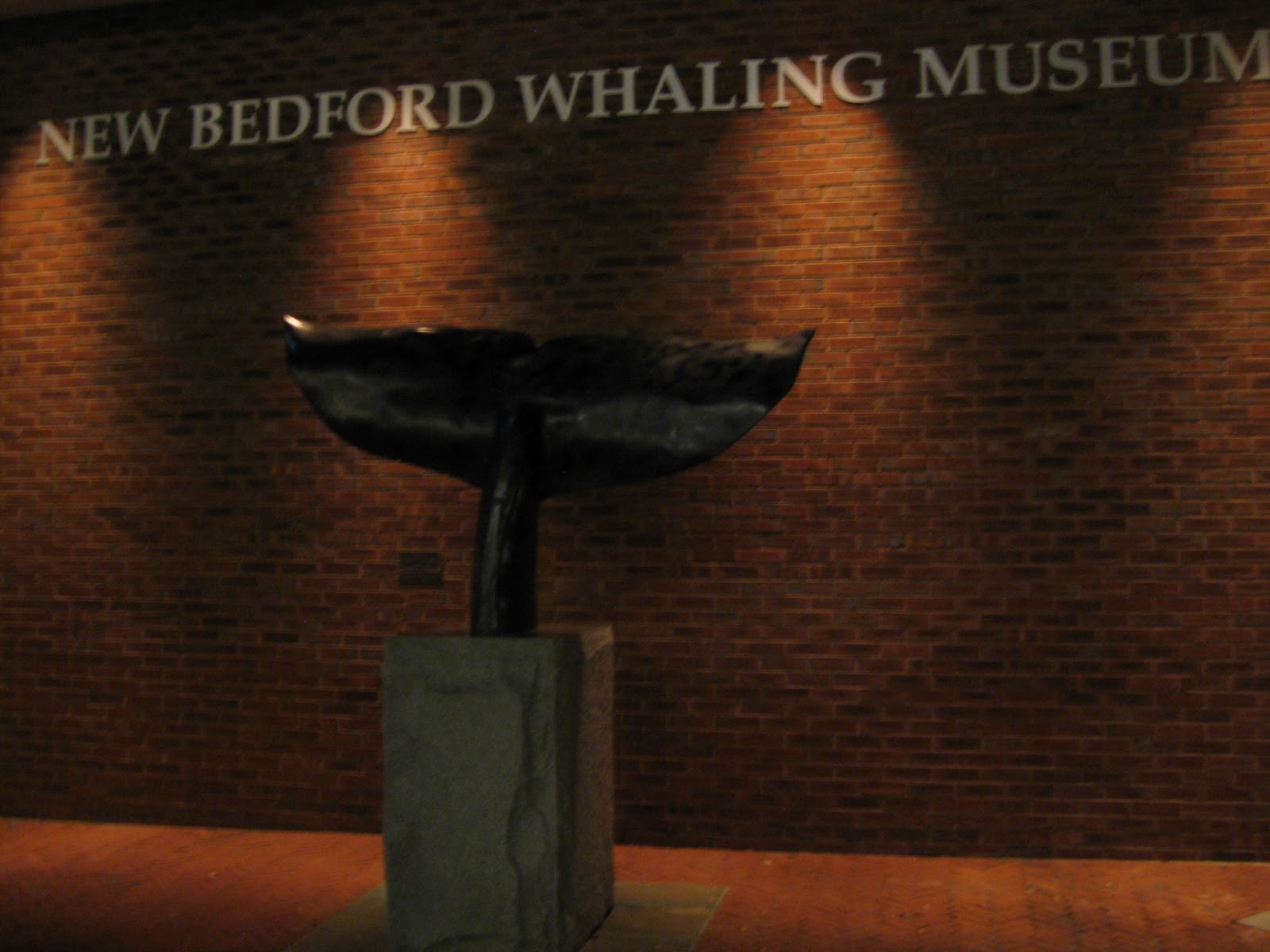
The New Bedford Whaling Museum's Moby-Dick Marathon is an annual non-stop reading of Herman Melville's literary masterpiece. The multi-day program of entertaining activities and events is presented every January. Admission to the Marathon is free.
Showing posts with label MDM16. Show all posts

Wednesday, January 2, 2013

Crack fellows all #4

...crack fellows all, and capital from boot-heels to hat-band.
                                                                                       - Chapter 101

 Tjitske and Tonnie at MDM16

Tjitske and Tonnie first ventured to New Bedford in 2011 for MDM15. Tonnie had read a recent, improved Dutch translation of M-D, then somehow heard about the Marathon. They came from their home in The Netherlands to celebrate his 50th birthday. Tjitske took the podium to read from The Whiteness of the Whale in her native tongue. (Listen to a clip.)

2011 was the year of the great snows in Massachusetts. The couple was "vacationing" in Boston while the city was paralyzed by repeated blizzards, but they took it in stride. Tonnie, a literature fan, wanted to visit Kerouac's grave in Lawrence. We drove to the cemetery, but could not find the flat marker under two feet of fresh snow!

They returned for MDM16, where Tjitske read again in Dutch; and they will be back for MDM17! Tjitske is assigned a 10:10 A.M. time slot (Sunday, Jan. 6) to read (in  Dutch, of course). That will be 4:10 P.M. in the Netherlands, so their friends can watch her on the live webcast.

Tonnie finds parallels between Ahab and General Custer. (There's a topic for a beer-fueled discussion!) Tjitske notes that "speksynder" of Chapter XXXIII is a corruption of the Dutch "spek snijder" ("fat cutter" or "blubber cutter," as explained in M-D). Somehow the original snijder (pronounced "snyder") became "synder." Whale in Dutch is walvis; blubber is walvisspek.

Respect is due: the Dutch ruled the oceans for generations. They were hunting whales around Greenland as early as 1586, according to Ashley's The Yankee Whaler, and it wasn't until the late 1700s that their whale fishery was "on the wane" (Ashley, p.26).

Look for Tjitske and Tonnie at MDM17, and say hi.

Wednesday, December 26, 2012

Crack fellows all #3

...crack fellows all, and capital from boot-heels to hat-band.
                                                                                       - Chapter 101

Shoko at MDM16

I'd be surprised to see Shoko at MDM17. When I met her at MDM16, she was on a one-year sabbatical from a "small, private university" in Japan, where she teaches "American culture." She asked the Friday-night panel of scholars about Fedallah as an Asian stereotype, but the format of "Stump the Scholars" didn't permit a full exploration of the issue. Pity.

After five months in Buffalo, Shoko was on her way to NYU. She was looking forward to meeting her son in New York.

It was Shoko who hipped me to the Frederick Douglass Marathon — Thank You and Best of Luck to you and your family!

(Details of the 2013 Frederick Douglass Marathon will be posted in January.)

Tuesday, December 18, 2012

Crack fellows all #2

...crack fellows all, and capital from boot-heels to hat-band.
                                                                                       - Chapter 101

Larry & sons at MDM16

Bleary-eyed at the end of MDM16
Interesting guy, Larry. A psychiatrist on Long Island, he drove up with his sons, Eric and Brian, for their second (at least) Marathon. If you stayed for the entire reading, you heard his "New Yawk" accent at the podium, and saw the trio in their sleeping bags in the wee hours.

If you've ever wondered about the motivations of Ahab, Ishmael, or any of the others, talk to Dr. Larry. He's given M-D a lot of thought. (His take on the Town Ho story is that it's a mirror image of the story of the Pequod and its crew.)

As a psychiatrist, Larry is equipped to illuminate aspects of M-D the rest of us might overlook. Have you ever thought about Ahab's mother? She's mentioned once (Chapter 16), but the Doctor finds clues there that explain Ahab's later-life "issues."

If you see Dr. Larry, Eric, and Brian at MDM17, say hi.

Tuesday, December 11, 2012

Crack fellows all

...crack fellows all, and capital from boot-heels to hat-band.
                                                                                       - Chapter 101

Rhonda at MDM16

I bumped into Rhonda in the break room a bit before dawn. She was agitated, excited; nervously paging through the M-D chapter she expected to read. (Such expectations are rarely met, due to the differences in speed and quality of the readers who precede you, and the judgement of the volunteer "officer of the watch" then on duty.)

Rhonda is a local textile artist with her studio in New Bedford. She's also a fan of Nathaniel Philbrick. After years working in the city, she thought she'd take a shot at the Marathon. She had never read M-D, but prepared by listening to the book on tape (repeatedly) while working.

If you see Rhonda at MDM17, say hi.

BTW, her reading was just fine.

Thursday, February 16, 2012

The 16th New Bedford Moby-Dick Marathon -- Scholar "Chats"

photo: Metro Library and Archive
For the second year in a row, the Marathon offered "Chat with a Melville Scholar." The scholars were available in a side-gallery, for two hours Saturday afternoon and one hour Sunday morning. I imagined this as sort of a visit to the library's reference desk — you ask your question, get your answer, and move on — but it turned out to be much more.

On Saturday I walked in on scholars Wyn Kelley (M.I.T.) and Timothy Marr (UNC), engaged in a free-form discussion with a small knot of marathoners. Ms. Kelley called me over to join the group. Other marathoners, as well as scholars Mary K. Bercaw Edwards (U. of Conn.) and Chris Sten (George Washington U.), wandered in until the circle swelled to over twenty.

There followed a sort of Master Class on "Moby-Dick and other matters arising," with insights voiced from all quarters. Among the "audience" were several students of literature, and a number of amateurs who clearly had given M-D a lot of thought. (Marathoners are fascinating people.)

Scribbling notes as fast as I could, I walked away with "leads" that could occupy this Melville dilettante for months:
  • The Art of Fielding; fiction, somehow relevant
  • seek out Lisa Norling's history of whalers' wives
  • something about the 1919 centennial of Herman's birth, biographer Raymond Weaver, and his connection to Maria Melville (HM's mother)
  • Eleanor Melville Metcalf (HM's granddaughter) shared Herman's papers with biographers to fuel the "Melville Revival" of the 1920s. (Wyn Kelley has a paper about this, available online.)
  • M-D could be read as a poem; Melville's poem Clarel is significant
  • something about Hassidic texts' "holy life point" in all creatures
  • an interesting digression concerning Irish authors
  • something about Irish writer Walter Macken (sp?) and his poem "The Great Pyramid"
  • relevant: Whitman's poem Crossing Brooklyn Ferry
  • In Chapter 24, The Advocate, Ishmael's voice changes from that of greenhand to shipwreck survivor
  • M-D as "The Book of Ishmael," scripture of the final religion
  • When was Ishmael recounting his story (M-D)? Where? In Lima?
  • see "the Ibis trilogy" by Gaosh
  • Freud's writings similar in some ways to M-D
  • Freudian analysis of Ahab; in Chaper 119, The Candles, Ahab asks the Almighty, "what did you do with my mother?"
  • Ahab as the hero, as he "rages against mortality," going up against something "epically monstrous"
The scholars displayed their pedagogic talents, too, drawing each of us into the discussion, and considering all comments with respect. Those "rock stars" of Melville scholarship treated us as colleagues, or at least coreligionists.

I made sure to join the group again on Sunday. Although many in the group were enervated from all-night marathoning, this session was even meatier. There was a long (and long-overdue) discussion of what we might charitably call the racially insensitive passages in M-D. (From the looks on people's faces, it seemed several of us would have liked to consider this topic further.)

Then came a bomb.

Someone asked, "What did Steelkilt say to the captain?" (in Chapter 54, The Town-Ho's Story).

Ms. Berkaw-Edwards told us that there were stories of a woman in the days of sail who disguised herself as a man and joined a crew in the forecastle. "He" was reportedly the toughest seaman (sea-person?) on the ship. The disguise was only discovered when "he" was about to be flogged for some infraction. (Lemuel might have more to post about this.)

A scholarly marathoner added to this shocker, positing that Gabriel of Chapter 71, The Jeroboam's Story, was Steelkilt after "he" had left the Town-Ho. Gabriel's coat is described so as long-skirted, and it was the crew of the Town-Ho that told the tale of Gabriel to the Pequod's crew.

My head was spinning as we returned to the reading in the atrium. Melvillians, both professional and amateur, know that M-D contains worlds within worlds. It was clear then that within those worlds every word matters.

Update, 12/10/13: Re-reading Chapter 54, Steelkilt is described as having "a flowing golden beard like the tassled housings of your last viceroy's snorting charger." So it's unlikely "he" was a "she." Steelkilt does whisper something upsetting to the captain and Radney—did he have some dirt on those two?

Matryoshka 1

Saturday, January 14, 2012

The 16th New Bedford Moby-Dick Marathon -- the Wee Hours on the Third Day

According the New Bedford Whaling Museum's blog, the 16th Moby-Dick Marathon attracted a record number of visitors -- more than 2,900 over the weekend.  During most of the reading on Saturday, there were few or no empty chairs, unless you resorted to the overflow seating in the Cook Memorial Theater, where the reading was shown remotely with a slight delay. 

Spots in the main seating area, in the Jacobs Family Gallery, did not begin to free up until after the performance of Chapter XL ("Midnight, Forecastle") had concluded in the Theater, at about 10:00 p.m. as I recall.  From this point forward, the year-over-year increase in visitors became less noticeable.  There seemed to be a few more sleepers than at earlier MDMs stretched out on the mezzanine, and the number of awake participants seemed to dwindle more gradually, and to come not quite so close to zero, as in my previous years.


This increase in participation was good for all concerned -- except for us standby readers, whose chances of getting to read are inversely proportional to the number of people who show up.  I did get the opportunity to read once.  My selection happened to be "The Jeroboam's Story" (Ch. LXXI),  which I much prefer to what I read last year, about Derick De Deer and his lamp-feeder (Ch. LXXXI).  But neither I nor any of the other stand-bys had the chance to read more than once during the course of the night.


Just as in MDMs past, between midnight and sunrise, those who remained, and remained awake, were overtaken by the same surreal feeling of being trapped with Ishmael in a sea of darkness, listening to him go on and on, in a stream of seemingly inexhaustible eloquence, about Steelkilt and gams and tuns and sharks and whale skeletons and monstrous pictures and Malaysian pirates.  Meanwhile, the snack food in the break room slowly disappears, while each cup of coffee and tea you drink has less effect than the last.  Close to dawn, like Ishmael trying to make a bed out of a bench at the Spouter Inn, you find that every position you assume is uncomfortable. 

A few times, to stretch my legs, I went out into the dark to get some shots of the deserted New Bedford streets.  By this time, the unusually balmy weather had turned colder.  It was still not as bone-chilling as in prior years, but at least I now found it easier to relate to impoverished Ishmael when he wandered the wintry New Bedford waterfront in search of economical lodgings.

The Rodman Candleworks and part of the "Double Bank" on Water St.
Looking south on Water St. behind the Museum

Friday, January 13, 2012

The 16th New Bedford Moby-Dick Marathon -- Second Day (Part Two)

Immediately after the "Stump the Scholars!" program, the scholars headed over to the Lagoda Room to conduct a reading of the Extracts that preface Moby-Dick.  This was the first time in the history of the New Bedford MDM that the Extracts have been included in the reading.  In prior years, the Marathon has always skipped the Extracts and begun instead with Chapter I ("Call me Ishmael" etc.) -- something that we and other fans have deplored in the past.

Wyn Kelley reads an extract.
The idea behind this Extracts reading was excellent.  The plan was to begin the Extracts at 11:30 a.m. and get through as many of them as possible before noon.  That way, the Marathon formalities could still commence on schedule at the same time as in every other year, without the necessity of determining precisely how long it would take to read all the Extracts.  The scholars stood around the balcony of the Lagoda Room and took turns reading one extract each, an arrangement that made it easy to separate one extract from another and that spared the readers the trouble of reading the source after each extract. 

Jennifer Baker reads; Mary Bercaw Edwards waits her turn.
There was just one problem, which I don't think anyone could have foreseen:  The audience did not seem to grasp that this was part of the reading of Moby-Dick.  Instead of listening quietly as they do to every other part of the book, the audience members talked over the readers as if Melville were just background noise.  As a result, it was nearly impossible to hear the Extracts.  I don't know whether this happened because most people didn't understand what was going on, or because a small number of talkers caused everyone else to give up and talk too, or because most people just don't like the Extracts.

Whatever the cause, I hope the Museum will continue to include the Extracts in future years.  Perhaps if they began the Extracts reading by having someone ring a bell or blow a bos'n's whistle from the podium, and announce what is about to take place, the audience will be more attentive.

After the Extracts, I went out to grab some lunch and take pictures around town.  Gansevoort stayed on and later attended a sort of round-table discussion with the scholars and other serious fans, something I'm sorry to have missed and expect he will write about in the days to come.

Wednesday, January 11, 2012

The Kids Are Alright

The under-20s were well represented this year. Gives one hope, eh?
Sat. 5:08 PM Sat. 5:09 PM Sun. 12:11 AM Sat. 9:26 PM

The 16th New Bedford Moby-Dick Marathon -- Second Day (Part One)

Saturday (Jan. 7) began with the second annual "Stump the Scholars!" program in the Cook Memorial Theater at the Whaling Museum.  This event was organized the same as last year's, except many more people participated this year, and the audience's questions were (I thought) tougher.  Anyone who had a Moby-Dick-related question for the scholars (from the Melville Society) could write the question on a form and be assigned a number, first come, first served.  Then the questions would be posed in numerical order to two teams of three scholars each (named the "Clams" and the "Cod," after Chapter XV, "Chowder").  A team who answered a question satisfactorily would be awarded points; if neither team was able to answer, the questioner received an "I Stumped the Scholars" button.

The Scholars
It's no easy task to "stump" teams like these. We're talking about some of the rock stars of Melville studies, with knowledge broad and deep. From the left in the photo above:
  • Mary K. Bercaw Edwards (U. of Connecticut)
  • Robert Wallace (Northern Kentucky U.)
  • Wyn Kelley (M.I.T.)
  • Chris Sten (George Washington U.)
  • Laurie Robertson-Lorant (U. of Massachusetts Dartmouth)
  • Jennifer Baker (NYU)
Michael Dyer works the crowd
The judge and scorekeeper, as last year, was Michael Dyer, the Museum's Maritime Curator. He did a great job, balancing entertainment and erudition. In the end, he was as surprised as anyone (i.e., no one) that once again the teams were tied!

The questions ranged from gimmes to true head-scratchers.  E.g.:
- In what country was Ishmael when he related the story of the Town-Ho? (Answer: Peru)
- What is a sword-mat? (Answer: a fender or bumper for a boat)
- How many words are in Moby-Dick? (I think this was a gag question, but Robert Wallace made an educated guess that came very close to the correct number.)
- A complex question about synchronicities that I didn't follow.
- What once celebrated, later notorious, American military figure was instrumental in the creation of Moby-Dick?  (Answer: Benedict Arnold, who [if I heard correctly] saved the life of the future Mrs. Peter Gansevoort, Herman Melville's maternal grandmother.  This stumper was the work of Peter Whittemore, who earned a button thereby.)

Shortly before the program started, Gansevoort and I had some excitement when I unintentionally outed us as the authors of this blog.  It happened when I asked Michael Dyer if I could take his picture for a blog.  When I said the word "blog," a voice behind me cried out, "Ahab Beckons?  Are you Ahab Beckons?"  I turned around to find Jim Lopes, VP of Education and Programming at the Museum.  By reacting, I had already betrayed myself.  Jim then introduced himself and asked me if I was Gansevoort.  I said no and led him into the theater, where Gansevoort was sitting.  Jim explained that (unknown to us) he and others had been speculating on our identities and had even asked the assembly at the end of the buffet dinner whether "Ahab Beckons" was in attendance.  (This was apparently after we had moved into the theater to get settled for Dr. Marr's lecture.)

In a whirlwind, Jim then introduced us to an assortment of notables, including Peter Whittemore (Melville's great-great-grandson), Robert Rocha (the Museum's Science Director and the commander-in-chief of this year's Marathon; he also read a chapter in Portuguese), Wyn Kelley, and Brian Witkowski (the Museum's Education Programs Manager).  With the help of our sister, we managed to get photos of some of the above, which are posted below.  After the "Stump" program, the Museum's Director of Digital Initiatives, Michael Lapides, also introduced himself.  Everyone was very gracious, and their kind words of encouragement were most appreciated.

Peter Whittemore
Robert Rocha
I'm positive that we also took a picture of Jim Lopes and Brian Witkowski, but I can't find it on my camera.  (Ynot explains in the comments that this may be the result of photographer's error.)

Alternative photo of Jim Lopes, at the podium Friday evening


Tuesday, January 10, 2012

The 16th New Bedford Moby-Dick Marathon -- First Day

Gansevoort and I arrived at the New Bedford Fairfield Inn within minutes of each other on Friday afternoon.  He had driven down from Waltham, and I had taken the train from Wilmington to Providence, where my sister (who was also heading to the Marathon) picked me up for the drive from Providence to New Bedford.  We dropped our bags and walked over to Freestone's (a/k/a "The Marathoner's Rest") for a pre-Marathon-buffet drink.

Melville fans arrive early to get good seats for the lecture
This was our first year attending the Marathon buffet dinner, a pleasant, communal way to kick off the Marathon activities. Our table included my sister and brother-in-law, the Dutch Melvilleans Tjitske Zwerver and Tonnie Schakenraad, and RISD professor Burton Van Name ("Van") Edwards, with whom I had a nice chat about parchment, papyrus, and points.

After dinner and a quick trip to the museum shop, we headed into the Cook Memorial Theater for this year's lecture, "Moby-Dick in American Popular Culture," by Timothy Marr of UNC.   The lecture -- illustrated with photos, videos, and music -- earned lots of laughs, as we watched clips of cartoons, video games, and movies, very, very loosely inspired by Moby-Dick.  (Professor Marr omitted one Moby-Dick by-blow, however: Age of the Dragons, starring Danny Glover as Ahab.)  Among the photos were some intriguing, and some just plain odd, covers of editions of Moby-Dick from the collection of our blogging compatriot Bill Pettit.

After the lecture, we strolled back to the hotel to rest up for the main event.

Sunday, January 8, 2012

Much more than we expected

MDM16 turned out to be much more than we expected. We met some interesting folks who greatly expanded our understanding of M-D.

It's going to take a while to unpack and process everything — photos and posts are coming. For now, we'll say:
Thanks to all involved! (and, only 363 days till MDM17).

Friday, January 6, 2012

Live streaming of MDM16

If you're not able to make it to New Bedford this weekend, you can watch a live stream of the entire Marathon. Last year's inaugural stream was very well done — the camera and audio techs stayed attentive for the entire 25 hours, following the Marathon as it moved to the Seamen's Bethel, and through several rooms in the Museum. The streams were available later as archived recordings. (You can view recordings of MDM15 now, although they may be replaced by MDM16.)

Note 1: My Safari browser under Mac OS X 10.5.8 has trouble with the video player, but Firefox works fine.

Note 2: If you tune in before the kick-off at Noon this Saturday, you may only see a static image or some canned footage.

Wednesday, December 21, 2011

The Extracts, yes!

Announced on the Whaling Museum's blog:
At 11:30 a.m. in the Bourne Building, Melville Society members will read many of the 80 brief "Extracts" related to whales and whaling, which Melville included before Chapter 1.
Is someone at the Museum reading this blog? Both Lemuel and I have argued that the MDM curiously omits two chapters of Moby-Dick: Etymology and Extracts. (And the Iron-Bound Bucket concurs!)

Now it appears that the MDM is, at least partially, addressing our pleas. (Why not read all of the Extracts? Why skip Etymology?)

Still, it's clear, the Marathon gets better every year!!

Note: The Bourne Building is that older part of the museum, which houses the Lagoda.

Friday, December 9, 2011

Get ready!

Here we are less than a month away from MDM16. If you cannot be in New Bedford the weekend of January 7 to read along, you can follow the event via the Museum's live video stream (details at above link), and monitor Twitter hashtag #MDM16.

If this is your first Moby-Dick Marathon, we hope that you will benefit from some of the posts on this blog. Lemuel has written on the physical and psychical aspects of the Marathon, and has a paean to the "Graveyard Shift". I culled from the Web recommendations on how to prepare for the all-night-on-your-blunt-end event. For your safety, see Lemuel's health warning.

If you have reserved a spot as a reader, or hope to be called as a standby reader, Lemuel's series can guide you (e.g., Rule 2: Speak the text, the whole text, and nothing but the text.).

Whether you make it to New Bedford this year or not, every mother's son and daughter needs a decent, printed copy of our treasured text. My search for the ideal edition of M-D should provide some grist for your mill.

Some info on parking, accommodations, and restaurants in New Bedford is here.

Finally, preparatory to casting off for the Whaling Museum, read our Marathoner's Checklist.

Saturday, October 15, 2011

Sign up now to read at MDM16

Quietly added to the Whaling Museum's MDM page was the call for Marathon readers:
Reservations to read are limited. Call (508) 997-0046, ext. 151.
Slots fill up well before January, so if you want to read (and be listed in the handout everyone gets), don't procrastinate.

If you're planning on staying for the entire reading, you can sign up as a standby reader when you arrive for the Marathon.  No guarantees that you'll be called to the podium, but there always seems to be a need for readers in the small hours of Sunday morning.

Friday, September 30, 2011