Thursday, March 31, 2011
Whaling Logs, as considered by one writer
There was an interesting post recently at the blog of writer and antiquarian book dealer, Gregory Gibson. Quite a Life peruses the "sub-genre" of whaling logs, with particular attention to the log of "The Bark Triton," which left New Bedford on October 10, 1860, not to return until April 23, 1865. Lots of scans of logs' original pages.


Monday, March 28, 2011
Holmes's "Revelation"
Oliver Wendell Holmes, Jr. -- the Supreme Court justice and son of the Autocrat of the Breakfast Table -- was among those readers who, in the 1920s, were delighted by a new discovery in American letters, a novel about whaling by an obscure 19th-century writer of travel narratives who had then been dead some 30 years:
The worlds of publishing, academia, and literary criticism have changed so much since the 19th century that it's almost impossible to imagine a work from the 1950s as great as Moby-Dick lying forgotten and largely unavailable for 70 years. English professors make careers out of burnishing the reputations of unjustly neglected authors (and even justly neglected ones; Peyton Place is now kept in print by Northeastern University Press, in a paperback edition with a scholarly introduction).
Did I mention my revelation ... ? Herman Melville and Moby Dick -- an account of sperm whaling with a story superadded. Anyhow I have finished it now and can say more certainly than ever that, with longueurs, it is, yet, I think, a mighty book. Not Shakespeare had more feeling of the mystery of the world and of life. There are mountain peaks and chasms -- and the whole is as thick with life at first hand now as the day it was written -- as Hawthorne's Scarlet Letter seemed to me thin, 20 years ago. (W[illiam] James replied to me when I said so, Because it is an original book.) Incidentally, it pleases me that he takes his fellow-sailors, a cannibal, an Indian, a negro and old Nantucket mates and captain with the same unconscious seriousness that common men would reserve for Presidents and Prime Ministers. And my, but he nobly exalts the Nantucket Whalemen, the Macys, the Coffins and the rest. I don't want to say too much but if you like George Borrow as I do I think this is a bigger man. If I made a shelf of strong impressions of recent years it would be an odd lot. Moby Dick beside Pearson's Grammar of Science or the best of Santayana or Lotze's Microcosmos.This comes from an April 14, 1921, letter from Holmes to Harold Laski, reprinted in part in Richard Posner's The Essential Holmes (1992). Holmes, born in 1841, was thus about 79 or 80 years old when he read Moby-Dick, and had been on the U.S. Supreme Court for 19 years. (He still had about 11 more years to go on the Court, clinging to his seat until his death in early 1932.)
The worlds of publishing, academia, and literary criticism have changed so much since the 19th century that it's almost impossible to imagine a work from the 1950s as great as Moby-Dick lying forgotten and largely unavailable for 70 years. English professors make careers out of burnishing the reputations of unjustly neglected authors (and even justly neglected ones; Peyton Place is now kept in print by Northeastern University Press, in a paperback edition with a scholarly introduction).
Sunday, March 27, 2011
Current Large-Print Moby-Dick
In a recent post at The Moby-Dick Collection, Mr. Pettit displays a nice-looking large-print edition of Moby-Dick, published in hardcover in 1969 by Franklin Watts, Inc. Unfortunately for me, I was not aware of this edition when I ordered a large-print Moby-Dick for myself from Amazon last year.
 This one is a paperback published by BiblioBazaar. According to Wikipedia, BiblioBazaar is a division or subsidiary of BiblioLabs LLC. BiblioLabs is in turn (according to its own website) "a hybrid software-media company, with a focus on using technology to enable curators and subject matter experts to create new works from the wealth of licensed, open source and public domain materials available within our core database."
Not surprisingly, therefore, BiblioBazaar's large-print Moby-Dick uses one of the uncorrected public-domain texts. This became apparent to me during the 2011 New Bedford Moby-Dick marathon, when I followed along in this version and began marking ways in which this text appeared to differ from what the readers were saying.
I bought a large-print edition because I wanted one that I could read comfortably at the podium without either stooping over it or holding it up to my face. This worked well for that, although as mentioned the text is not the most up-to-date. It's also a heavy one -- too heavy for Gansevoort, I'm sure, but I'm willing to put up with that. Indeed, the text is so large that I can just keep it open in my lap and follow along with no trouble.
It must be admitted, however, that this is no thing of beauty. It seems very much like a print-on-demand volume: just the text (with "Etymology" and "Extracts" at the end) and a non-specific cover.
Norton Critical Editions Moby-Dick
Signet Classics Moby-Dick
Penguin English Library Moby-Dick
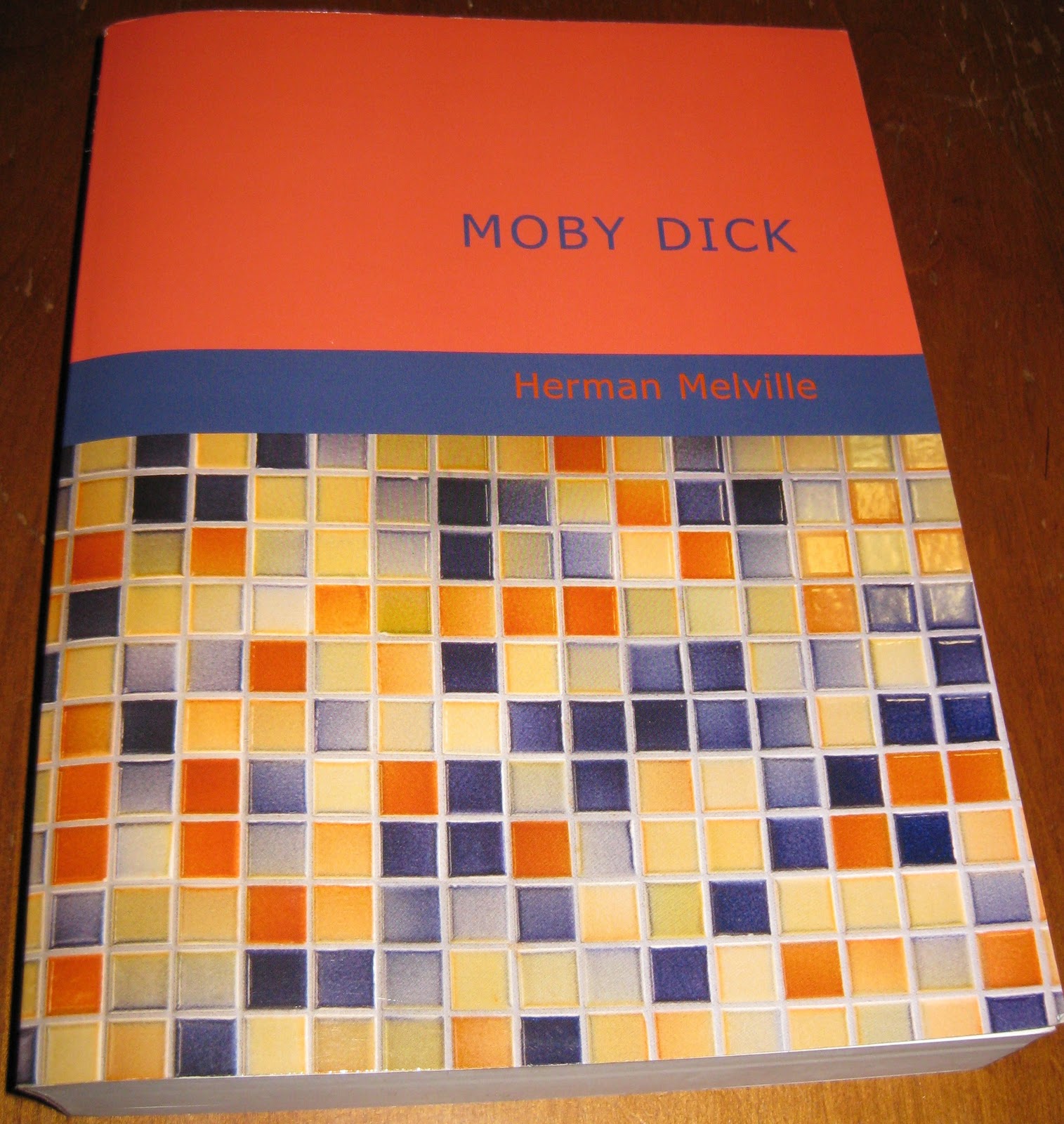
Not surprisingly, therefore, BiblioBazaar's large-print Moby-Dick uses one of the uncorrected public-domain texts. This became apparent to me during the 2011 New Bedford Moby-Dick marathon, when I followed along in this version and began marking ways in which this text appeared to differ from what the readers were saying.
I bought a large-print edition because I wanted one that I could read comfortably at the podium without either stooping over it or holding it up to my face. This worked well for that, although as mentioned the text is not the most up-to-date. It's also a heavy one -- too heavy for Gansevoort, I'm sure, but I'm willing to put up with that. Indeed, the text is so large that I can just keep it open in my lap and follow along with no trouble.
It must be admitted, however, that this is no thing of beauty. It seems very much like a print-on-demand volume: just the text (with "Etymology" and "Extracts" at the end) and a non-specific cover.
Norton Critical Editions Moby-Dick
Signet Classics Moby-Dick
Penguin English Library Moby-Dick
Saturday, March 26, 2011
Higgledy-Piggledy Whale Statements - 3
 For the film-fans among us, here's another interesting article in Cinefantastique: "Sons of Moby Dick: Melville’s White Whale has spawned a school of sea monsters." Author Steve Biodrowski discusses films that deal with scary things that come out of the ocean, including Godzilla, Jaws, Anaconda, and both the Gregory Peck and Patrick Stewart versions of our beloved tome.
Thursday, March 24, 2011
Today in History
From The New York Times, on this day in 1884:
...A whale was sporting in the waters off the south side of the island [Nantucket]... But alas! there was scarcely a vestige of whaling gear upon the island, so no effort could be made to capture his whaleship...
Wednesday, March 23, 2011
American Whalefleet - 1839
Here are some statistics that may be of interest, taken from the enlightening compendium The Yankee Whaler, by New Bedford native Clifford W. Ashley (author of The Ashley Book of Knots). This book seems to have been dropped by the publisher, Dover, but used copies can be found on Amazon. If you're interested in the history, practice, and nitty-gritty details of whaling, whaleships, and whalemen, it's a great resource.
Ashley took the following table from Charles Melville(!) Scammon. "It shows the size and distribution of the American fleet in the year 1839, when more ports were engaged in whaling than at any other time."
Wikipedia has articles to clarify the terms bark, brig, and schooner. (The distinction between "ship" and the others is unknown to me.) I sorted the table by tonnage, the total cargo carrying capacity of a city's fleet.
It's not surprising to see New Bedford, Nantucket, and Fair Haven at the head of the list. Ashley reports that by 1823 New Bedford's fleet equaled Nantucket's, both in numbers and tonnage. Sixteen years later, New Bedford's fleet was more than twice that of Nantucket in both measures.
Poughkeepsie and Hudson, lying 80 and 150 miles up-river from New York harbor, are a surprise. Of course, those are the cities of ownership, not necessarily the home port.
I was also surprised to see such major ports as New York, Portland, Portsmouth, and last-place Boston so far down the list; and to see New Jersey and Delaware there at all.
As of 1839, these states with "ocean access" were members of "the union," but are missing from this list: Pennsylvania, Maryland, South Carolina, Virginia, North Carolina, Louisiana, Mississippi, and Alabama. (Some of these states may have dabbled in whaling before or after 1839—Ashley writes that in the years after the War of 1812, i.e. after February 1815, Philadelphia sent out two whaling voyages.) Was that due to lack of capital, lack of a distribution system for product, greater demand for product in New England, or inability to compete against established whaling centers for talented shipwrights, officers, and crew?
Ashley took the following table from Charles Melville(!) Scammon. "It shows the size and distribution of the American fleet in the year 1839, when more ports were engaged in whaling than at any other time."
Wikipedia has articles to clarify the terms bark, brig, and schooner. (The distinction between "ship" and the others is unknown to me.) I sorted the table by tonnage, the total cargo carrying capacity of a city's fleet.
It's not surprising to see New Bedford, Nantucket, and Fair Haven at the head of the list. Ashley reports that by 1823 New Bedford's fleet equaled Nantucket's, both in numbers and tonnage. Sixteen years later, New Bedford's fleet was more than twice that of Nantucket in both measures.
Poughkeepsie and Hudson, lying 80 and 150 miles up-river from New York harbor, are a surprise. Of course, those are the cities of ownership, not necessarily the home port.
I was also surprised to see such major ports as New York, Portland, Portsmouth, and last-place Boston so far down the list; and to see New Jersey and Delaware there at all.
As of 1839, these states with "ocean access" were members of "the union," but are missing from this list: Pennsylvania, Maryland, South Carolina, Virginia, North Carolina, Louisiana, Mississippi, and Alabama. (Some of these states may have dabbled in whaling before or after 1839—Ashley writes that in the years after the War of 1812, i.e. after February 1815, Philadelphia sent out two whaling voyages.) Was that due to lack of capital, lack of a distribution system for product, greater demand for product in New England, or inability to compete against established whaling centers for talented shipwrights, officers, and crew?
| City where owned | State | Ships and Barks | Brigs and Schooners | Tonnage |
| New Bedford | MA | 169 | 8 | 56118 |
| Nantucket | MA | 77 | 4 | 27364 |
| Fairhaven | MA | 43 | 1 | 13274 |
| New London | CT | 30 | 9 | 11447 |
| Sag Harbor | NY | 31 | 10605 | |
| Warren | RI | 18 | 3 | 6075 |
| Salem | MA | 14 | 4265 | |
| Newport | RI | 9 | 2 | 3152 |
| Stonington | CT | 7 | 5 | 2912 |
| Hudson | NY | 8 | 2902 | |
| Edgartown | MA | 8 | 2659 | |
| Rochester | MA | 5 | 10 | 2615 |
| Falmouth | MA | 8 | 2490 | |
| Poughkeepsie | NY | 6 | 2043 | |
| Mystic | CT | 5 | 3 | 1797 |
| Bristol | RI | 5 | 1 | 1752 |
| Fall River | MA | 4 | 3 | 1604 |
| Wilmington | DE | 5 | 1578 | |
| Westport | CT | 5 | 4 | 1443 |
| Greenport | NY | 4 | 1 | 1414 |
| Lynn | MA | 4 | 1269 | |
| Holmes' Hole (Vineyard Haven) | MA | 3 | 1 | 1180 |
| Newburyport | MA | 3 | 1099 | |
| Providence | RI | 3 | 1086 | |
| Bridgeport | CT | 3 | 913 | |
| Plymouth | MA | 3 | 910 | |
| Wareham | MA | 2 | 2 | 904 |
| Dartmouth | MA | 3 | 874 | |
| New York | NY | 3 | 710 | |
| Coldspring Harbor | NY | 2 | 629 | |
| Dorchester | MA | 2 | 581 | |
| Portland | ME | 1 | 388 | |
| Wiscasset | ME | 1 | 380 | |
| Newark | NJ | 1 | 366 | |
| Portsmouth | NH | 1 | 348 | |
| New Suffolk | NY | 1 | 274 | |
| Jamesport | NY | 1 | 236 | |
| Provincetown | MA | 1 | 172 | |
| Somerset | MA | 1 | 137 | |
| Boston | MA | 1 | 125 |
Tuesday, March 22, 2011
Moby-Dick at SUNY Albany
The exhibit of a selection from Mr. Pettit's Moby-Dick collection is now open at the main library of SUNY's Albany campus. The exhibit focuses on foreign-language editions and on illustrations of Ahab. It will apparently be on view only through April 24, so don't procrastinate if you happen to be in the Albany area.
An interview with Mr. Pettit about his Moby-Dick obsession can be found here.
An interview with Mr. Pettit about his Moby-Dick obsession can be found here.
Subscribe to:
Posts (Atom)