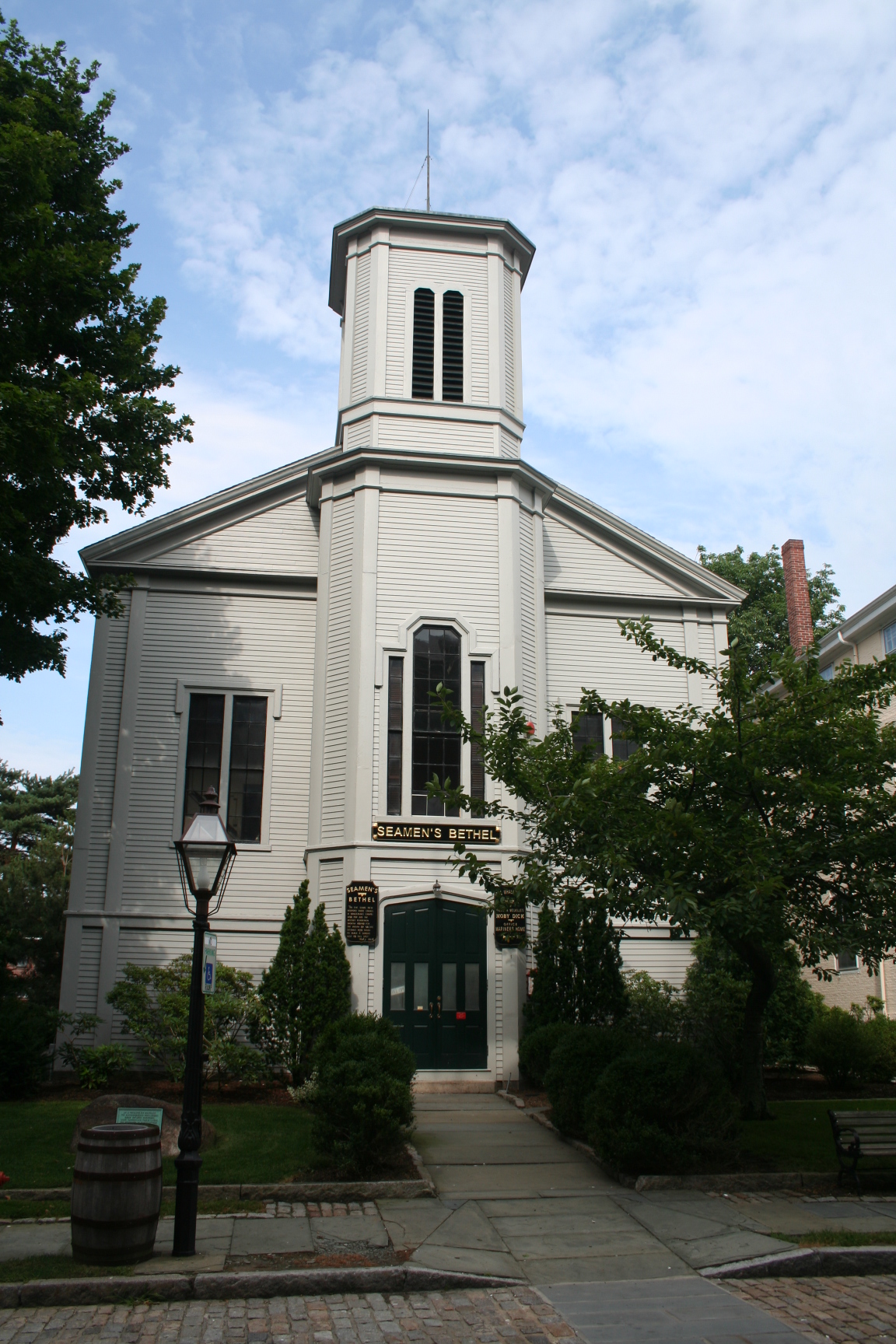
You can also enter the drawing for a seat at the historic Seamen’s Bethel, where chapters 7-9 are read/performed.
Don't dally. Registration usually closes within a few weeks.
(Yes, the twin podia are gone, replaced for MDM23 by two comfy chairs.)

Lemuel's post on Edward Thompson Taylor set me off on a wave of Web surfing.
"Father Taylor" is mentioned by name twice in Richard Henry Dana Jr.'s memoir, Two Years Before the Mast. Once for absolving seamen of blame should they consent to orders to work on a Sunday; once as a subject of conversation with the mates of the Lagoda (yes, that Lagoda, which was a merchant ship from 1826 to 1841), at anchor in San Diego:
One of their first inquiries was for Father Taylor, the seamen's preacher in Boston. Then followed the usual strain of conversation, inquiries, stories, and jokes, which one must always hear in a ship's forecastle, but which are, perhaps, after all, no worse, though more gross and coarse, than those one may chance to hear from some well-dressed gentlemen around their tables.
According to Find-A-Grave, Taylor's privateer was captured by the British, and he spent time in Dartmoor Prison. In 1847 he served as chaplain on board the U.S.S. Macedonian, transporting famine relief to Ireland, where he preached in Cork as well as Glasgow, Scotland. He is buried in Mount Hope Cemetery in Mattapan (south Boston).
The biography that Lemuel mentioned, Father Taylor, the Sailor Preacher, is here on Google Books. Of note is the following:
...1833, realized the completion, at the cost of twenty-four thousand dollars, of the world-known edifice, the Seamen's Bethel, North Square, Boston.
 In his dedication sermon, Taylor is quoted (p. 125):
America is the centre of the world, and the centre of America is Boston, and the centre of Boston is North Square, and the centre of North Square is the Bethel.
In 1847 the Mariner's House was built across the square from the Bethel. It still offers budget accommodations to working seamen.
According to northendboston.com, the Seamen's Bethel became the Sacred Heart Church after Taylor's death in 1871. It remains so today. Looking at an exterior photo, I have to wonder if any of the original Bethel was preserved. (Road trip, Lemuel!)
Emerson referred to Taylor as the "Poet of the Sailor and of Ann Street" (see Lem's post). Ann Street gets several mentions in Two Years Before the Mast as the seaman's main drag in Boston; e.g., "In a few hours I was down in Ann Street, and on my way to Hackstadt's boarding-house..."
Until 1852, when it was renamed North Street (which name it still carries) in an effort to improve its image, the infamous Ann Street area was known as the "Black Sea." In 1851, police "estimated that it was home to 227 brothels, 26 gambling dens, and 1,500 establishments that sold liquor." (Wikipedia)

Looking at the 1814 map above, you can see Ann Street running NNE along the wharves, becoming Fish Street, and passing the southern tip of the triangular North Square. (You can view the entire map at this Boston Public Library site.) Father Taylor's Bethel was across the street from the NE corner of North Square. The Mariner's House is on the West side of the square. Cross Street and Richmond Street, both running NW from Fish Street, exist today, but Ann/Fish Street is no longer the eastern-most street of this area.
 |
| Is this the face of Father Mapple? |
[Emerson] watched Taylor pacing his pulpit platform while the crowd gathered -- restive as a racehorse, beckoning tardy sailors to the front pews, imperiously waving at others to move over and make room. At forty-two he looked to be fifty, a wiry, weather-beaten man of middle height, his highly mobile face grooved with deep lines, his graying hair swept back, his Ben Franklin spectacles perched high on his brow, and the worn old Bible cradled in his arms. In due course he came forward to the lectern, "threw back his coat-collar, rolled up his cuffs, ran his fingers backward through his hair," and began to preach.Baker's chapter on Father Taylor includes evocative examples of his oratory, along with a discussion of his impact on Emerson's views of religion. The biographical details above are taken from Baker's book and from Father Taylor, the Sailor Preacher, an 1872 biography by Gilbert Haven and Thomas Russell (available on Google).
Behind him as he spoke was the only ornament in the chapel -- a large canvas depicting a ship in distress, braving the billows under lowering skies while mariners labored to keep the hulk afloat. It was a symbolic picture and the congregation knew it. Many a time in the heat and fury of his sermon he pointed it out as a graphic representation of the human predicament. He knew instinctively how to use it for maximum effect, owned the maritime experience and the idiomatic vocabulary to describe it, could in a twinkling summon up many a tale of disasters at sea, when the sailors "cried unto the Lord" and were yanked out of the maw of the deep by timely intercession....
"And so he went on," wrote Emerson, "this Poet of the Sailor and of Ann Street -- fusing all the rude hearts of his auditory with the heat of his own love and making the abstractions of philosophers accessible and effectual to them also."