The New Bedford Whaling Museum's Moby-Dick Marathon is an annual non-stop reading of Herman Melville's literary masterpiece. The multi-day program of entertaining activities and events is presented every January. Admission to the Marathon is free.
Showing posts with label road trip. Show all posts

Wednesday, August 8, 2018

Road Trip - Arrowhead MDM

Arrowhead farmhouse
To celebrate Melville's birthday, the Berkshire County Historical Society organized five days of events at/near Arrowhead farm. The centerpiece of their "Melville Week" was a (second annual) Moby-Dick marathon reading.

Like MDMs in New York and Provincetown, the BHS spread its reading across several days. Such an arrangement attracts local folks, who can sleep in their own beds and return fresh, but discourages out-of-towners from attending more than a couple of days. We made it to the fourth, final day.

Will there be an Arrowhead MDM for Melville's 200th birthday next year? We can hope. One might dream of a reading that takes place inside the actual home, and runs through the night to finish on August 1. (Are there any reports of hauntings at Arrowhead?)


The 2018 reading was held in the barn that houses Arrowhead's ticket office and museum shop.
Peter Bergman, Director of Communications for the BHS, recruited readers as we entered. He explained: read from the "podium copy" until the bell rings, then make a pencil mark where you stopped.

Each person read for ten minutes, after which Peter said something like, "Sarah, thank you so much," and called the next reader. Things proceeded calmly.

Like the Mystic MDM, no microphone was necessary. The group grew to no more than fifteen.

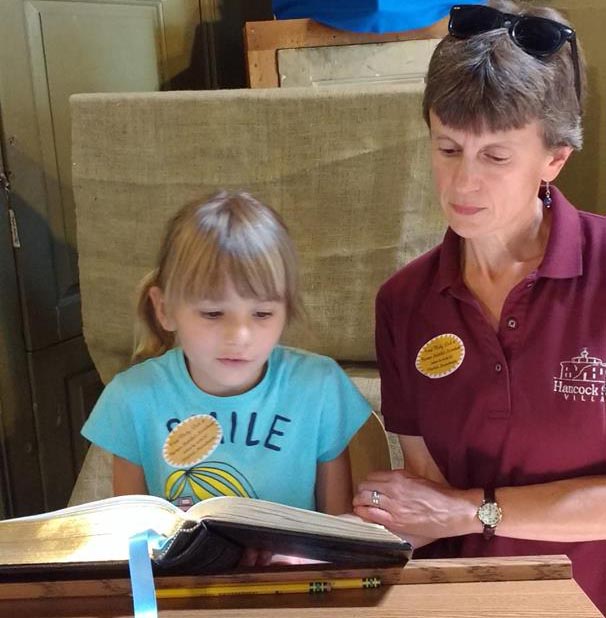
One reader stood out. She was maybe ten years old(?) and had very little problem with the knotty text. All the best to her, and her family!
A better photo, copied from the BHS Facebook page.
At the "Finis," Peter announced that over the four days of the marathon there were 85 different readers, plus 23 folks who simply listened.

Then he took his harpoon and posed for photos.

Mount Greylock on the horizon
(apologies for poor camera)

Thanks to the volunteers and staff of the Berkshire County Historical Society for a well run, "neighborly" MDM.


Saturday, August 4, 2018

Road Trip - Mystic Seaport MDM

Edited 10/20/2018 to add note about tick-borne infection.

Ahab Beckons finally made it to the longest-running Moby-Dick Marathon—that organized by the Mystic Seaport Museum. This (2018) was its thirty-third annual outing. Mystic sticks to a July 31 start, ending on August 1 (Melville's birthday), no matter the days of the week. If you're not willing to call in sick, tough toenails.

Side note: New Bedford adhered to a January 3 start (the date of Melville's sailing on the Acushnet) until MDM14 in 2010, if memory serves. It then settled on the first weekend after January 1, greatly increasing attendance.

Practical Matters

  • The entire reading takes place aboard the whaleship Charles W. Morgan. Overnight space is limited. Call a few weeks ahead to reserve. Details on the museum website.
  • There is ample free parking across the street from the Seaport; well signed.
  • You'll need to purchase admission to the Seaport area. Online tickets receive a 10% discount.
  • There is Wi-Fi in the Seaport area; spotty, as you'd guess. The entrance desk will give you the password.
  • Food and drink are not allowed on the Morgan. Water bottles were permitted. Some folks left their bag of provisions at the foot of the gangway, then left the ship to make a picnic. There is also a pub and sandwich shop on the grounds.
  • Experienced marathoners brought folding chairs. Recommended.
  • There is not a lot of shade or rain cover on deck; mosquitoes could be a problem; it can be chilly and damp at night. Be prepared.
  • The deck is not lit. Bring a lantern/flashlight/headlamp to read & maneuver.
  • Lots of folks slept on deck; bring a pad, pillow, and sleeping bag. Some slept below, where it was warm, stuffy, and brightly lit. Earplugs and a sleep mask are the ticket.
  • Organizers maintained a sign-up sheet by chapter number. Each reader delivered an entire chapter. (Yes, even The Town Ho's Story!) If you have a favorite chapter, talk to the staff early.
  • Check with the entrance desk if you want to leave the Seaport. There should be no problem getting back in.
  • The Seaport area is closed from 6 P.M. until 9 A.M. The marathon staff will tell you how to get out/in after hours.
  • Don't mess with the ropes (sheets, halyards, and stays) or belaying pins!
 Photo: Gilles Renault

"Post-Mortemising" the Mystic MDM

Noon: Board the Morgan from the port side, and try to find a spot in the shade of the "spare boat rack." (What's the correct term?)

The Morgan has a tiny cabin (built for a captain's seasick wife) in the center of the deck, just before the mizzen-mast. Readers stand aft of the mainmast and address the audience sitting on either side of that cabin.

"Mr. Melville" recites the Loomings chapter from memory(!); something of a tradition, I gather. Sorry I didn't get his name, or thank him for his fine performance.

There is no podium, no microphone. Almost all readers are clearly audible; some painfully so. Every reader gets a round of applause when finished.

The ship remains open to museum visitors. Tourists filter through the reading and stare at us as if we're some weird exhibit.

3:30 P.M. A group of staff members boards and goes about reefing the sails for the night. Fascinating, exacting, tough physical work. The reading continues as we try to stay out of their way.

6 P.M. The museum closes, leaving fewer than twenty of us marathoners to carry on through the night. The sounds of the tourists and the working harbor are replaced by the chirps of crickets and the whine of the I-95.

As darkness gathers, we feel like a group of friends sitting around a campfire or in someone's living room.

5 A.M. BYOL - Bring your own light!
6 A.M. The dawn brings showers. Deck-sleepers are driven under the "boat rack" or below deck.

7 A.M. Staff prepares for another day. An anachronistic truck rolls down the quayside to collect the previous day's trash. Local sportsfolk shoot along the river in their sculls.

9:30 A.M. Veteran sailor and Melville scholar, Mary K. Bercaw Edwards directs staff members as they set the Morgan's sails for the day. She announces that a whale will be sighted soon...

11:25 A.M. "The Chase — Third Day"
Ahab howls. Mr. Melville waits to read "Epilogue."

11:30 A.M. A watch in the crow's nest calls "There she blows!" Mary K. and staff demonstrate the lowering of a whaleboat (a non-trivial task).
11:45 A.M. All ashore to celebrate Melville's 199th birthday with cake!
Nearly all the readers at Mystic seemed to be very conversant with the text. Their delivery was smooth and confident. This might be a by-product of the marathon falling mid-week when "youngsters" are less able to attend. There were never more than about thirty attendees, so lots of folks read multiple times. (When the marathon falls on a weekend, is the ship overcrowded?)

All-told, this was a cozy MDM, without the technology and "stage management" of the New Bedford MDM. Nor did Mystic have the ancillary events we love in New Bedford: "Stump the Scholars" and "Scholar Chats." Still, an MDM set on an authentic whaleship in a pretty harbor on a beautiful summer evening is not something to miss.


Tick-borne infection

The south coast of Connecticut is prime country for Lyme disease. Did I pick up a tick on the Morgan (perhaps carried aboard by a mouse), or while strolling the grounds of the Seaport, or while hiking in western CT the week before?
The day after the Mystic MDM, I began to feel a cold coming on. Within another day or two, this developed into all the symptoms of the flu, minus the congestion. "Flu" in summer leads one to suspect Lyme disease. My doctor put me on doxycycline and took blood. Test results came back quickly. Diagnosis: anaplasmosis—which merited a third week of doxycycline. Now, nearly three months later, crisis seems to have been averted, but I lack the stamina to backpack in the mountains (as I've done every summer for years). Full recovery is expected, but it's slow in coming.
If I were to return for another Mystic MDM, I would bring my own chair, sleep in that chair, treat socks & shoes with permethrin, and avoid walking through the grass.

Monday, February 10, 2014

Road Trip: Frederick Douglass Read-A-Thon

Just back from the 14th Annual Frederick Douglass Read-A-Thon—a public through-reading of Narrative of the Life of Frederick Douglass, sponsored by the New Bedford Historical Society.

This year, the reading moved to the First Unitarian Church, on Eighth Street in New Bedford. This is a beautiful church, built in 1838. We were told that Frederick Douglass' first paying job in New Bedford was at this very church, shoveling coal for the minister's wife!

The sanctuary could have seated three or four times the number of folks who showed up. Where was everyone? This would be a great afternoon with your middle-school or high-school kids; and if you've never read this historic memoir, all the more reason to come next year. You won't regret it.


Tuesday, March 5, 2013

Road-Trip: Frederick Douglass Read-A-Thon

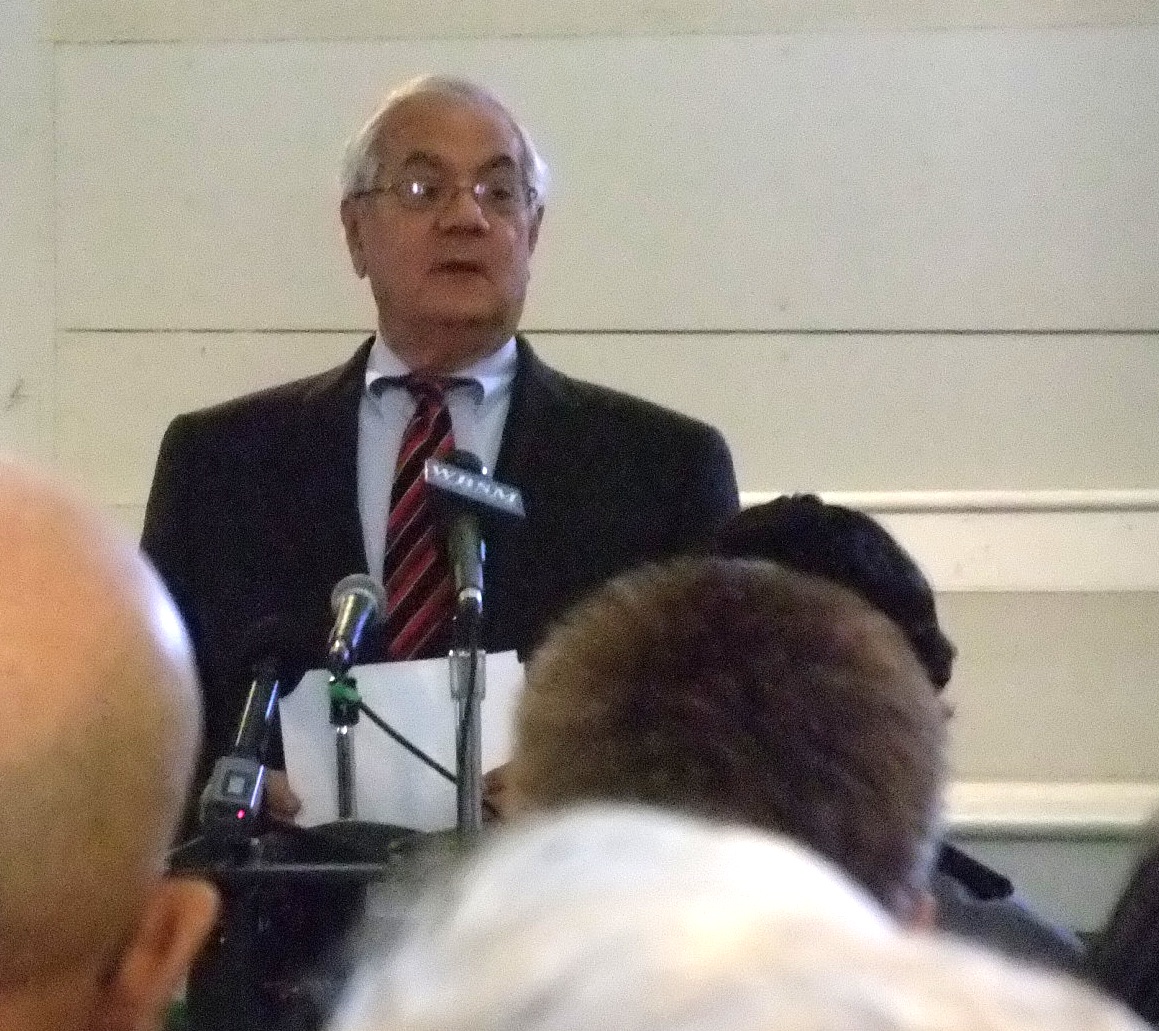
The 13th Annual Frederick Douglass Read-A-Thon was held as (re-)scheduled this past Sunday. In contrast to last year's event, we weren't graced with the presence of Miss New Bedford or Barney Frank. We did, however, hear excellent readings from two young men—one barely taller than the podium. (That's the kind of thing that renews one's faith in the future.) Also reading were two MDM regulars: Michael Dyer (Maritime Curator of the Whaling Museum) and Jennifer Nersesian (in her National Historical Park uniform).

The New Bedford Quakers were early proponents of abolitionism, organizing their anti-slavery society in 1834. Frederick Douglass and his wife settled in New Bedford after his escape from slavery in 1838.

The local paper, The Standard-Times, covered the event.

Monday, February 6, 2012

Road Trip - Frederick Douglass Marathon

Just back from the Twelfth Annual Frederick Douglass Community Read-A-Thon of Narrative of the Life of Frederick Douglass, An American Slave, Written by Himself. This is presented by the New Bedford Historical Society, and seemed to be "directed" by Melville biographer Laurie Robertson-Lorant (of MDM "Stump the Scholars" fame). What a great way to kick off Black History Month!

I got to New Bedford early and took advantage of the balmy (for February) weather to roam the neighborhood. First stop: the Lewis Temple statue in front of the Public Library. Temple was a blacksmith, and inventor, who moved to New Bedford in the 1820s. Clifford Ashley in The Yankee Whaler notes that, with the opening of the Kodiak whaling grounds in 1835, whalemen observed the walrus and seal spears of the indigenous hunters. Their detachable spear-head was seen as being more effective than the flexible, single-flued iron then prevalent in whaling. "Over one hundred harpoon patent applications were filed in Washington within the next few years." In 1848, Lewis Temple came up with a design that "was of such extremely simple construction, and at the same time was so practical, that it was at once adopted to the exclusion of all others." Ashley continues...
With but one small change , to permit easier manufacture, it has continued to be the standard harpoon of the fishery. ... It is safe to say that the Temple toggle was the most important single invention in the whole history of whaling, since it resulted in the capture of a far greater proportion of the whales that were struck than had before been possible.
Temple's design was never patented. Upon his death, the statue's plaque informs us, "after business debts were cleared, there was no legacy left for his family."
On the next block is the Frederick Douglass Monument. From the website of the New Bedford Historical Society:
This monument is dedicated to Frederick Douglass and his wife Anna who escaped slavery by the underground railroad and made New Bedford their home for five years 1838-1843. Two of their children were born here, Rosetta (1839) and Lewis (1840). Dedicated on October 17, 1996, this monument commemorates the 100th anniversary of his death in 1895. Sponsored by the City of New Bedford and the New Bedford Chapter of the NAACP.
Friends Meeting House
Then it was on to the Friends Meeting House for the reading. For veterans of the Moby-Dick Marathon, this was like a small-town "fun run." The audience is smaller (maybe peaking at 100), the text is short (about 100 pages), the duration is brief (about 4.5 hours), and readers don't have to struggle with arcane references (Euroclydon anyone?).

Each reader was assigned a specific passage. Dr. Robertson-Lorant distributed the texts — five or six pages printed in a comfortably large font, stapled together. All attendees were given a Dover edition of Douglass's work, to follow along. A generous spread of food and drink was available in the adjoining hall.

Marlena Johnson
Rep. Barney Frank
Mayor Jon Mitchell
Rep. Wm. Keating
I arrived few minutes early and was struck by the sight of a young woman wearing a tiara! The program revealed that she was the 2012 Miss New Bedford, Marlena Johnson. She kindly posed for a blog photo. (Talk about poise!)

Ms. Johnson opened the event with a superb rendition of "Lift Every Voice." There followed a presentation to U.S. Representative Barney Frank, and a few introductions and announcements. Dr. Mary Louise Francis, Superintendent of Schools, was warmly applauded for her declaration that the Douglass autobiography will be "mandatory reading for New Bedford public schools."

Then we were off. Mr. Frank read first, followed by New Bedford mayor Jonathan Mitchell, and U.S. Representative William Keating.

A few familiar faces from MDM16 were among the readers -- Jen Nersesian (in her Nat'l Historical Park uniform), Scott Lang, Jim Lopes, and Michael Dyer.

Most impressive were the youngest readers, from local grammar and middle schools. I'd say that the future is in good hands.

Scanning the audience, I was reminded of the ethnically diverse New Bedford of Chapter 6 in M-D. We were a mix of cultures, of backgrounds, of ages; husbands and wives, parents and children. While the text described extreme cruelties, we pondered it together, and together marveled at one man's strength and intelligence. Was I the only one who felt a tacit, mutual pledge to look for the best in each other?

Young readers
Young readers
Jim Lopes
Dr. Laurie Robertson-Lorant

Friday, August 5, 2011

Road Trip - When Herman met Hawthorne

161 years ago today, Herman Melville met Nathaniel Hawthorne. The influence that this meeting had on Moby-Dick is a subject for another time. For now, let's say that it wasn't for nothing that M-D was inscribed to Hawthorne.

If you can't make it to the "Hawthorne & Melville Annual Hike" up Monument Mountain this Sunday (Aug. 7), you can browse a commemorative road-trip here. I drove out to western Massachusetts two days ago for a quick snapshot safari, but found that every answer led to more questions.

View from Melville's "piazza"
First stop, Arrowhead. I got in on the lightly attended (three visitors, total) penultimate tour of the day. Our guide was well-practiced and very knowledgeable. (We were told that Hershel Parker bought Herman & Lizzie's bed at auction and donated it to Arrowhead. A national treasure is Mr. Parker. Most of the details here are taken from his biography of Melville.) The place is in great shape inside, thanks to the off-season work of skilled volunteers.

Pontoosuc Lake, Pittsfield
Thursday, August 1, 1850 was Melville's 31st birthday.  Two days later, a group from the Melvill farm (purchased by Herman in September, 1850 and named "Arrowhead"), including visitors Evert Duyckinck and Cornelius Matthews, took a fishing trip to Pontoosuc Lake, on the other side of Pittsfield. Duyckinck and Matthews had been invited out to the farm by Herman. The following day, August 4, was Herman and Elizabeth's third wedding anniversary.

Stockbridge station
Monday, August 5, 1850, Melville, Duyckinck, and Matthews took the train to Stockbridge, where Dudley Field (Jr.) had arranged for the two out-of-towners to meet "all the celebrities of Stockbridge" (Parker). There they met Field and Oliver Wendell Holmes. Holmes's grandfather owned 24,000 acres in the Berkshires—a valuable holding as the coming of the railroad in 1850 led to the development of the area as a playground for the rich. Arrowhead is on Holmes Road; Oliver had a summer home down the road, on the river.

The four went to the Field "cottage" in Stockbridge, then set out for Sacrifice Mount as a "rehearsal, for the grand climb." I could find no location for Sacrifice Mount or the Field home. Parker mentions that the cottage is (was?) "on the village green ... [a] square, red-brick house later known as the Old Parsonage." Note that the well-to-do referred to their Berkshire homes as "cottages" in the same way that the Vanderbilts and the Astors referred to their palaces in Newport.

Returning to the Field cottage, the four were joined by James T. Fields (publisher of The Scarlet Letter) and his wife, Henry Sedgwick ("of the famous Stockbridge family" [Parker]), and Mister Nathaniel Hawthorne. (So, Melville and Hawthorne actually first met at Field's house in Stockbridge!)

From Monument Mountain
"Miss Jenny Field" (Dudley's sister?) came along as all ten rode out to Monument Mountain "in three conveyances." There is no record of the actual route they hiked. We know they abandoned the wagons partway up the mountain. They got caught in a rainstorm, drank some champagne, listened to Matthews recite poetry, and watched Herman climb out on a rock, pretending it was a bowsprit.

The mountain is now owned by The Trustees of Reservations. (Download a trail map here.) I hiked up the west side. The trail followed an old dirt road until it became steep, so I imagine this was their route. On a humid August day, this was a good workout — not a hike I'd enjoy in long woolen trousers, no matter how much champagne was on offer. Some photos from the trail are in this album.

In the Ice Glen
The group then returned to the Field cottage for a big, well-lubricated turkey dinner. Joel Tyler Headley dropped in and induced the men to hike the "Icy-Glen" (mentioned in Moby-Dick, Chapter 102). This is a short hike, just a few blocks from the Red Lion Inn in Stockbridge center. See the album for all the photos and information. Bring bug dope and shoes with good traction. On a humid day the mossy rocks are slippery. I did get a few drafts of cool air, but there was no ice to be seen. The route is unobtrusively engineered to aid the visitor through the boulder field, with stone steps and bridges. An alternate fork on the trail toward the Glen makes a sweat-inducing, mosquito-infested climb to an observation tower ("Laura's Tower") with limited views.

The party returned again to the Field house, and at 10 P.M. the three from Pittsfield took the train home. The brakeman consented to pause the train near the Holmes Road crossing, saving them a two-mile walk back from the Pittsfield station. Duyckinck and Matthews stayed at the Melvill farm that night.

So ended the Big Day. It led to the birth of Moby-Dick as we know (and love) it. And it was all orchestrated by David Dudley Field. More about him in a subsequent post.

Sunday, April 3, 2011

Road Trip - SUNY by way of Arrowhead

Expanded my carbon footprint today, driving out to the State University of New York, Albany to see Bill Pettit's exhibit of some of the highlights from his Moby-Dick Collection. (All Over Albany has a nice interview with Mr. Pettit.)

Drove the back roads to Arrowhead, knowing it's closed until Memorial Day weekend, but hoping to get a few snaps. Passed groves of sugar maples, tethered together with what looks like surgical tubing, collecting sap into plastic holding tanks; cubes, about 5-feet on each side. (Forget about galvanized pails and horse-drawn sleds!) A couple of sugar houses were in operation, steam pouring out of their vent windows. Lots of work and sweat to yield that pint of syrup. For God's sake, be economical with your pancakes and waffles!

Passed Miss Hall's School, "one of the foremost college-preparatory schools for girls in the country," established 1898. I hope the girls study Moby-Dick—they're just a short walk from Arrowhead.

stealth-photo of kitchen
Stealth-photo of kitchen
There was a crew of about eight men (volunteers, and definitely not unskilled) working on the rear addition to the original house. At some point (in the 1940's, guessing from the wallpaper), there were four apartments and three bathrooms in this wing. The volunteers were in the process of removing the bathrooms (to save on property taxes, I was told). I was led up the back stairway, through an old kitchen, to see Melville's library, freshly painted, and the newly opened "Hawthorne room" (not yet furnished). Whatever its age, the wing felt solid underfoot, like it was built with pride. Thanks for the tour, guys!

On to the big city (Albany), and the State University of New York. Wouldn't you like to be a fly on the wall of an architecture class at this school? That's a carillon next to the skating rink / landing pad / Unisphere plinth. The library is behind the carillon.

Steel yourself and enter the cage labeled "Library."

The Moby-Dick exhibit is just inside the entrance, arranged in two cases.

One display of eight English-language editions, from 1930 to 1989, each opened to an image of Ahab.


One display of foreign-language editions, together with some "artifacts" from the career of the estimable Professor Hugh Maclean—his "study copy" with his penciled notes in the margins, and...

...his "First-Day Cover" of the "Herman Melville" 6-cent envelope, postmarked "New Bedford, March 7, 1970."

Mr. Pettit reflects on the "meaning" of the exhibit on his blog. In whatever form our beloved texts come to us, they are the result of the dedication and skill of untold numbers of our forebears, who worked to pass an author's creation ahead to one more generation of readers.