The New Bedford Whaling Museum's Moby-Dick Marathon is an annual non-stop reading of Herman Melville's literary masterpiece. The multi-day program of entertaining activities and events is presented every January. Admission to the Marathon is free.
Showing posts with label books. Show all posts

Wednesday, December 12, 2018

Norton Critical Editions of Moby-Dick x3

Originally published February 10, 2018;
Edited to append Gansevoort's "Physical Notes."
Norton Critical 1st, 2nd, and 3rd -- Collect 'em all.

I just got the "Third Norton Critical Edition" of Moby-Dick (NCE3).  I had to order it through a third-party seller on Amazon, and it shipped from Europe.  At the moment, it doesn't appear to be available at all on Amazon, whether from Mr. Bezos himself or a third-party seller.  Oddly, even the publisher's website shows only the second edition right now.  A number of sellers at ABE Books (which has become an affiliate of Amazon) are offering it, however.

First, let me say how surprised, pleased, and honored I am to see Gansevoort's (mainly) and my humble efforts mentioned on page 687, in Mary K. Bercaw Edwards and Wyn Kelley's essay (written specially for NCE3), "Melville and the Spoken Word."  The essay digs deep below the surface of the Moby-Dick Marathon phenomenon, which is more extensive than even I had realized.  Of all the books that could have inspired so mighty a sound, why Moby-Dick?

Second, I am surprised and pleased to see that, while NCE3 does not have an apparatus as extensive as that of NCE1, the editor, Hershel "Mr. Melville" Parker, has provided a convenient list of emendations, something that was entirely absent from NCE2.  (This is the first Norton Critical Moby-Dick not to be co-edited by Harrison Hayford, who died in 2001, shortly before NCE2 came out.)

Between NCE1 and NCE2, the explanatory footnotes to the text itself were greatly and usefully expanded.  As far as I could tell from a quick spot-check, the footnotes in NCE3 have not changed from those in NCE2 (although a few have been split into multiple notes).  That's all to the good, as far as I'm concerned -- the quantity of footnotes in NCE2 was just right.

This is a new edition because the assortment of goodies at the end of the volume has been switched up, just as with NCE2.   Among the newcomers are Prof. Parker's "Glimpses of Melville as Performer" and six essays under the heading "Moby-Dick in the Twenty-First Century" (where Mary K. Bercaw Edwards and Wyn Kelley's entry appears).

But this is only a glimpse of how NCE3's critical caboose differs from that of NCE2.  Though my opinion is not entirely disinterested, all three editions are well worth having.

Norton Critical Editions Moby Dick [NCE2 vs NCE1]


Added by Gansevoort, 12/12/2018.

Physical Notes


NCE3 is a "tighter" publication than NCE2. The pages are the same height, but are slightly narrower (by about 3/32"). The font, font size, and leading are identical. (See the Typeface Tally.) The width of the text block on the page is the same; however, top and bottom margins are reduced in NCE3, displaying 51 lines of text per page where NCE2 displayed 50. (The line breaks have changed, too; usually, but not always, rendering the same text in fewer lines.)

The net result is that NCE3 presents Etymology through FINIS in 405 pages vs. NCE2's 421—3.8% fewer pages. Less wood is good, right?

Measuring the thickness of 100 pages in each edition with calipers, the paper stock in NCE3 is about 14% thinner than that of NCE2. (The stock feels almost like bible leaves.) The show-through is about the same in each.

Appreciation


Hershel Parker, now in his eighties, has blogged that NCE3 marks "the end of a long career." The three Norton Critical editions represent over fifty years of rigorous work. Thank you, Mr. Parker.

Wednesday, May 23, 2018

Latest News from the Feejees - 10

50,000,000 Shades of Grey fans can't be wrong...

Edited 10/23/2018 to add final votes.
MDM regulars will recognize Mary K. Bercaw Edwards, making the case for Moby-Dick as the "best-loved book" in The Great American Read on PBS. An experienced sailor, Melville scholar, and a pillar of MDMs at the Whaling Museum and Mystic Seaport, Ms. Bercaw Edwards knows whereof she speaks.

The 2-hour broadcast can be streamed on the program's home page. Skip to time 56:00 to hear why M-D is that fabled "great American novel."

It would be petty to gripe that this whole "list & vote" thing is a meaningless popularity contest skewed by the whims of ill-informed adolescents and political/religious zealots, so let's ignore that. No "Top x" list can satisfy everyone. (Where the dickens is Joyce's Ulysses?) Still, taken for what it is, this list might point you to a good read, and might point some wanderer to Moby-Dick.
10/23/18 - This just in: Moby-Dick ranked as #46 (higher than I would have predicted).
To Kill a Mockingbird was voted #1.

Saturday, March 10, 2018

The Amazing Internet


In 1935, George Bernard Shaw remarked that thanks to the radio, he could hear more good music in a week than he could have heard "in ten years, if at all," back in the 1880s when he was writing music criticism in London.  Shaw's startling demonstration of the cultural impact of technology often recurs when I think about everything the Internet makes available today.

As recently as twenty years ago, you would have had to turn to the best university libraries if you wanted to consult the enormous mass of printed material you can now read, wherever you are (just about), with a few keyboard taps.  Earlier this week, while rereading the selection in the Norton Critical Edition 2nd from a 1992 paper by Geoffrey Sanborn, I wanted to take a look at the 1823 review essay by Sir Francis Palgrave, "Superstition and Knowledge," that Sanborn shows was one of the minor tributaries feeding into Melville's mind as he toiled over Moby-Dick.  After two or three minutes of searching, I found the very thing, starting at page 245 of this collection of Palgrave's writings.  Not only was it fast; I could save it as a searchable PDF for future reference.  And no scrounging for coins to feed into a smelly library copying machine.

I well remember how excited I was, in the early 1990s, to learn that the nearest state university library had a full set of Robert Southey's The Doctor, which is often mentioned as a possible inspiration (in form) for Moby-Dick.  But now Southey's work is at my fingertips, at any time and from time to time.

And just take a look at this, courtesy of Harvard and Mr. Google.  O brave new world, that has such resources in 't!

Sunday, February 18, 2018

Moby-Dick: The World's First Imperial-Gothic Novel?


Illustration from H. Rider Haggard's The Ivory Child (1916).

Today it's no great revelation that Melville uses a number of typically Gothic elements in Moby-Dick.  There's even a Yahoo! Answers answer on the subject.  Back in 1949, Newton Arvin -- a far greater authority than any of us anonymous Internet wayfarers -- wrote a highly readable article on Melville's Gothic touches, "Melville and the Gothic Novel" (New England Quarterly, vol. 22, no. 1, 33-48 [available at JSTOR with free registration]). As Arvin observed, Melville's imagination was "profoundly Romantic, in one of the largest senses of the word, ... and to say so is to say, especially for an English or American writer, that the Gothic or Radcliffean was almost certain to be a minor ingredient in its complex totality."

Consider, for instance, the (usually female) protagonist who slowly begins to realize, with ever increasing dread, that she has become caught in the power of a man both tyrannical and malevolent.  For post-Moby-Dick examples, think of Laura Fairlie in The Woman in White (1859) or Maud Ruthyn in Uncle Silas (1864) or Jonathan Harker in the first four chapters of Dracula (1897).  In Moby-Dick, Ishmael's misgivings about the voyage and about Captain Ahab in particular slowly accumulate as he considers the "wicked king" who bore Ahab's name, the dark hints from Elijah, and other red flags.  By the time Ishmael's fears are confirmed in "The Quarter-Deck" (Ch. 36), he has effectively no escape from Ahab's grasp.

(Critics have noted the overall passivity of Jonathan Harker -- a male narrator filling the Gothic role of the young maidenly heroine around whom older, stronger figures are spinning their webs.  In one of Dracula's most memorable scenes, Harker lies supine at the mercy of three predatory females, fearing and desiring their kisses/bites.  Interestingly, the passivity of the mild-mannered Ishmael, another male narrator in the role of the Gothic heroine, becomes explicit in his relations with Queequeg. Awaking in bed with the thoroughly masculine Queequeg's arm around him, Ishmael acquiesces in the embrace, and later he figuratively becomes Queequeg's wife.  And in both narrators, their passivity is abetted by the vulnerability of their positions as employees -- Harker the young solicitor who wants to please a rich client, Ishmael the lowly greenhand put upon by mates and captain.)

While Moby-Dick carried forward much of the Gothic machinery developed in the previous century by Ann Radcliffe and others, it also paved the way for what is sometimes termed Imperial Gothic.  Imperial Gothic is a sub-genre that flourished around the end of the nineteenth century.  It is best exemplified by the lost-world fantasy-adventures of Conan Doyle and H. Rider Haggard, in which intrepid explorers venture beyond the farthest reaches of the English Empire, into such as-yet-unexplored regions as central Africa, and there confront "the Other" in the form of prehistoric peoples, dinosaurs, giant crabs, witches, and supernaturally vicious elephants and apes.

A modern example of the Imperial Gothic form that will be more familiar than Conan Doyle's and Rider Haggard's ripping late-Victorian yarns is the 1933 film King Kong.  Following the standard structure, the film uses the trip to a distant, uncharted location to instill in the audience Gothic terror -- i.e., the fear of the unknown, of an evil that is sensed but cannot (yet) be fully articulated.  From the start, we are given hints that the protagonists are on their way toward something horrifying: movie director Carl Denham, famous for wildlife films made at great personal risk, is outfitting for his greatest undertaking yet; he's been having trouble finding any actress willing to appear in the film; the ship he's chartered is loaded with enough explosives and ammunition to blow up New York harbor; the island he's headed for is not shown on any map, its only inhabited portion cut off from the rest by a gigantic wall built centuries ago by a people far more civilized than the current natives -- evidently to "keep something out."

Melville did much the same thing 80 years earlier.  The United States at the time did not have an empire strictly speaking, but whalemen were the pioneers of its commercial empire in the Pacific, as Ishmael explains in "The Advocate" (Ch. 24).  The Pequod travels to the farthest ocean wastes to encounter Moby-Dick, the unnatural, the monster, the Gothic horror.  Like the scriptwriters for King Kong, Melville builds up in his audience a fear of the approaching unknown.  The monstrous painting in the entry of the Spouter-Inn, the cenotaphs in the Seamen's Bethel, the backstory of Ahab's disfigurement and ensuing delirium, the spirit-spout, all the sidebars about the great size and strength of the sperm whale and the dangers involved in hunting it -- these are just a handful of ways in which Melville creates dread in the reader as the Pequod sails farther from the safe world of civilized America and closer to the deadly clash with Moby-Dick.


Saturday, January 27, 2018

Moby-Dick Written in the Style of White-Jacket

White-Jacket; or, The World in a Man-of War is, needless to say, Melville's fifth book and the one that immediately preceded Moby-Dick.  Some critic somewhere (Newton Arvin perhaps?) characterized White-Jacket as not fiction, but journalism.  Whoever said that, it's a fair characterization -- the book is, at least on its surface, a straightforward account of Melville's experiences serving on the USS United States in 1843-44, lightly dramatized and padded out with stories he'd picked up from other sailors and with some editorializing about the U.S. Navy (including his celebrated condemnation of flogging).

Only a year after White-Jacket's appearance (in 1850), Melville gave the world Moby-Dick.  I'm sure no one interested in the New Bedford MDM has to be told that the two books are as different as night and day. Or maybe distant thunder vs. lightning just outside your window would be a truer contrast.

It is widely believed, I think, that Moby-Dick started out as another White-Jacket, this time set on a whaler and with a bit more excitement to improve sales.  But along the way -- as happened with Mardi (1849) and Pierre (1852) -- something in Melville took over, and the work was transformed.

Yet what if Melville had been able to stick to the White-Jacket formula?  What would a "journalistic" Moby-Dick be like?  You can get a rough idea by reading Nimrod of the Sea; or, The American Whaleman.  Published in 1874 and now readily available on the Internet, Nimrod is a memoir by William M. Davis (1815-91) of his voyage on the whaler Chelsea in 1834-38.   It is based on a journal Davis kept intermittently during the voyage, but (as he explains) he fleshes that out with "the experiences and adventures of others, such as I have been enabled to pick up in the form of yarns on board the Chelsea," incorporating "the experiences of a quarter of a century."


Nimrod describes countless details of the work that whale hunting and processing involved (many of which will be familiar to Moby-Dick fans) and aspects of the whaleman's life in the Pacific that Moby-Dick doesn't touch (such as stopping at the Galapagos Islands for tortoises that would later be killed for fresh meat at sea, and dealing with the "land sharks" who inhabited barely civilized ports on the west coast of South America).  And Davis recounts the conclusion of the hunt, the demolition of the try-works (when its bricks were joyously thrown overboard), and the return home -- topics that Moby-Dick doesn't get into, for obvious reasons.

While Davis doesn't mention Moby-Dick or Melville anywhere in his memoir, he has a few passages so reminiscent of the earlier work that it's hard to imagine he hadn't read it.  One example is the semi-erotic "spermaceti bath," when Davis and his mates use their bodies to process the material from the "case" in the sperm whale's head:
With our hands blistered yesterday by the oar, and all on fire to-day by the harsh friction of the handspike, it was luxurious to wade deep in the try-pots filled with this odorous unguent, in order to squeeze and strain out the fibres, which, if allowed to remain, would char with the heat, and darken the oil. No king of earth, even Solomon in all his glory, could command such a bath. I almost fell in love with the touch of my own poor legs, as I stroked the precious ointment from the skin.
Another example is the cautious, halting way in which the mates go to dine with the captain:
The steward comes up the companion-way, and touching his greasy Scotch cap, announces, "Captain B----, dinner is on." "All right;" and the captain takes a turn by the binnacle, if we are running a course, and peeps at the compass. Then in the companion-way, on his way down he stops, takes a long look at the sails, and, as it were, a last farewell of the light of heaven. "Mr. F----, dinner is on." "Ay, ay, sir," says the mate, as he strolls to weather-deck. Now Mr. F---- takes a shorter peep at the compass, and, pausing in the companion, he, too, takes his upward survey. The two other mates go through precisely the same performance, only according to their respective ranks they take yet shorter peeps at the compass and glance heavenward. They then arrive simultaneously at the table, to find the captain and Mr. F---- leisurely in their second plateful. Now, the misery of the arrangement is in this: the officers must come up in reversed order -- third, second, first mate, and lastly the captain. A third mate has thus only about seven and a half moments to dispose of his grub. The old man last of all appears on deck, picking his satisfied teeth in the most tantalizing manner, and the four boat-steerers next make a dash for the table, and make clean sweep of the remnants.
Don't those descriptions sound familiar! 

Unlike Moby-Dick, Nimrod doesn't involve a white whale or a stove ship (although Davis does provide a yarn about the sinking of the Nantucket whaler Union after being rammed by a whale).  Also unlike Moby-Dick, Nimrod does include illustrations -- quite a few, and quite detailed.  If some of them look familiar, it's probably because you've seen them in the commentary at the end of the Norton Critical Edition of Moby-Dick (with appropriate credit, of course).

(For the details on William Davis, thanks to Honore Forster's annotated bibliography on 19th-century whaling in the Pacific, The South Sea Whaler, published in 1985 by the Kendall Whaling Museum, Sharon, Mass., and Edward J. Lefkowicz, Inc., Fairhaven, Mass.)

Thursday, December 19, 2013

Gift idea! (even if it's for yourself)

Released this year: Melville Biography,
An Inside Narrative
For the Melvillian on your list is this unclassifiable tome by Hershel Parker: Melville Biography, An Inside Narrative.

"Unclassifiable" because it is part autobiography, part rebuttal of his critics, part explication of his approach to biography, part continuation of his monumental Melville biography.

More than that I hesitate to say—because I've only just started reading it, and because my ignorance in these matters is vast. For a real review, see this one by Carl Rollyson, himself an accomplished biographer. (You may need a Wall St. Journal account to load the review. I was able to view it once; no longer. If you have access to back issues, it's in the 3/29/2013 WSJ.) A slightly condensed version of Rollyson's review is here, about halfway down the page.

I can tell you that it is interesting reading. (Be sure to read the Notes in the back, too.) 

Sunday, April 3, 2011

Road Trip - SUNY by way of Arrowhead

Expanded my carbon footprint today, driving out to the State University of New York, Albany to see Bill Pettit's exhibit of some of the highlights from his Moby-Dick Collection. (All Over Albany has a nice interview with Mr. Pettit.)

Drove the back roads to Arrowhead, knowing it's closed until Memorial Day weekend, but hoping to get a few snaps. Passed groves of sugar maples, tethered together with what looks like surgical tubing, collecting sap into plastic holding tanks; cubes, about 5-feet on each side. (Forget about galvanized pails and horse-drawn sleds!) A couple of sugar houses were in operation, steam pouring out of their vent windows. Lots of work and sweat to yield that pint of syrup. For God's sake, be economical with your pancakes and waffles!

Passed Miss Hall's School, "one of the foremost college-preparatory schools for girls in the country," established 1898. I hope the girls study Moby-Dick—they're just a short walk from Arrowhead.

stealth-photo of kitchen
Stealth-photo of kitchen
There was a crew of about eight men (volunteers, and definitely not unskilled) working on the rear addition to the original house. At some point (in the 1940's, guessing from the wallpaper), there were four apartments and three bathrooms in this wing. The volunteers were in the process of removing the bathrooms (to save on property taxes, I was told). I was led up the back stairway, through an old kitchen, to see Melville's library, freshly painted, and the newly opened "Hawthorne room" (not yet furnished). Whatever its age, the wing felt solid underfoot, like it was built with pride. Thanks for the tour, guys!

On to the big city (Albany), and the State University of New York. Wouldn't you like to be a fly on the wall of an architecture class at this school? That's a carillon next to the skating rink / landing pad / Unisphere plinth. The library is behind the carillon.

Steel yourself and enter the cage labeled "Library."

The Moby-Dick exhibit is just inside the entrance, arranged in two cases.

One display of eight English-language editions, from 1930 to 1989, each opened to an image of Ahab.


One display of foreign-language editions, together with some "artifacts" from the career of the estimable Professor Hugh Maclean—his "study copy" with his penciled notes in the margins, and...

...his "First-Day Cover" of the "Herman Melville" 6-cent envelope, postmarked "New Bedford, March 7, 1970."

Mr. Pettit reflects on the "meaning" of the exhibit on his blog. In whatever form our beloved texts come to us, they are the result of the dedication and skill of untold numbers of our forebears, who worked to pass an author's creation ahead to one more generation of readers.

Friday, April 1, 2011

"A Reader's Guide to Herman Melville"

It took me three tries before I finally succeeded in making it all the way through Moby-Dick.  If memory serves, I was 12-14 years old when I made my first two attempts (inspired by seeing the 1956 film version on TV).  Both times, I don't think I made it out of New Bedford.  By the time of my third attempt, I was a junior in high school.  My English teacher -- appropriately named Mrs. Fish -- required each of us to write a term paper on an American author selected from a list approved by (I presume) the school board.  We had to research our chosen author's life, read at least two of his or her books, and look into some of the relevant critical literature.

Title page to Syracuse's facsimile reprint
I chose Melville.  To aid me, I borrowed from the school library A Reader's Guide to Herman Melville, by James Edwin Miller, then-chairman of University of Nebraska's English Department.  Published in 1962, this was one in a series of "Reader's Guides" to various authors put out by Farrar, Straus and (it seems; information is sketchy) also distributed by Octagon Books and Thames & Hudson.  Another volume in the series, A Reader's Guide to James Joyce, came into my hands the following year and was still kicking around my parents' house as recently as 10 years ago. 

Recently, I returned to Miller's book to see how much of it, if anything, I retained after thirty-odd years.  It is now available in a paperback facsimile reprint by Syracuse University Press (with a new and very unappealing cover) and can also be found in Google books, surprisingly.

I did not retain much, as it turns out.  I can put my finger on only two things: Miller's map of the overall flow of Melville's output, and his interpretation of White Jacket's discarding his coat as an affirmation of "involvement" in the human condition.

"Something further may follow this Masquerade" -- tomorrow, perhaps.

Sunday, March 27, 2011

Current Large-Print Moby-Dick

In a recent post at The Moby-Dick Collection, Mr. Pettit displays a nice-looking large-print edition of Moby-Dick, published in hardcover in 1969 by Franklin Watts, Inc.  Unfortunately for me, I was not aware of this edition when I ordered a large-print Moby-Dick for myself from Amazon last year. 

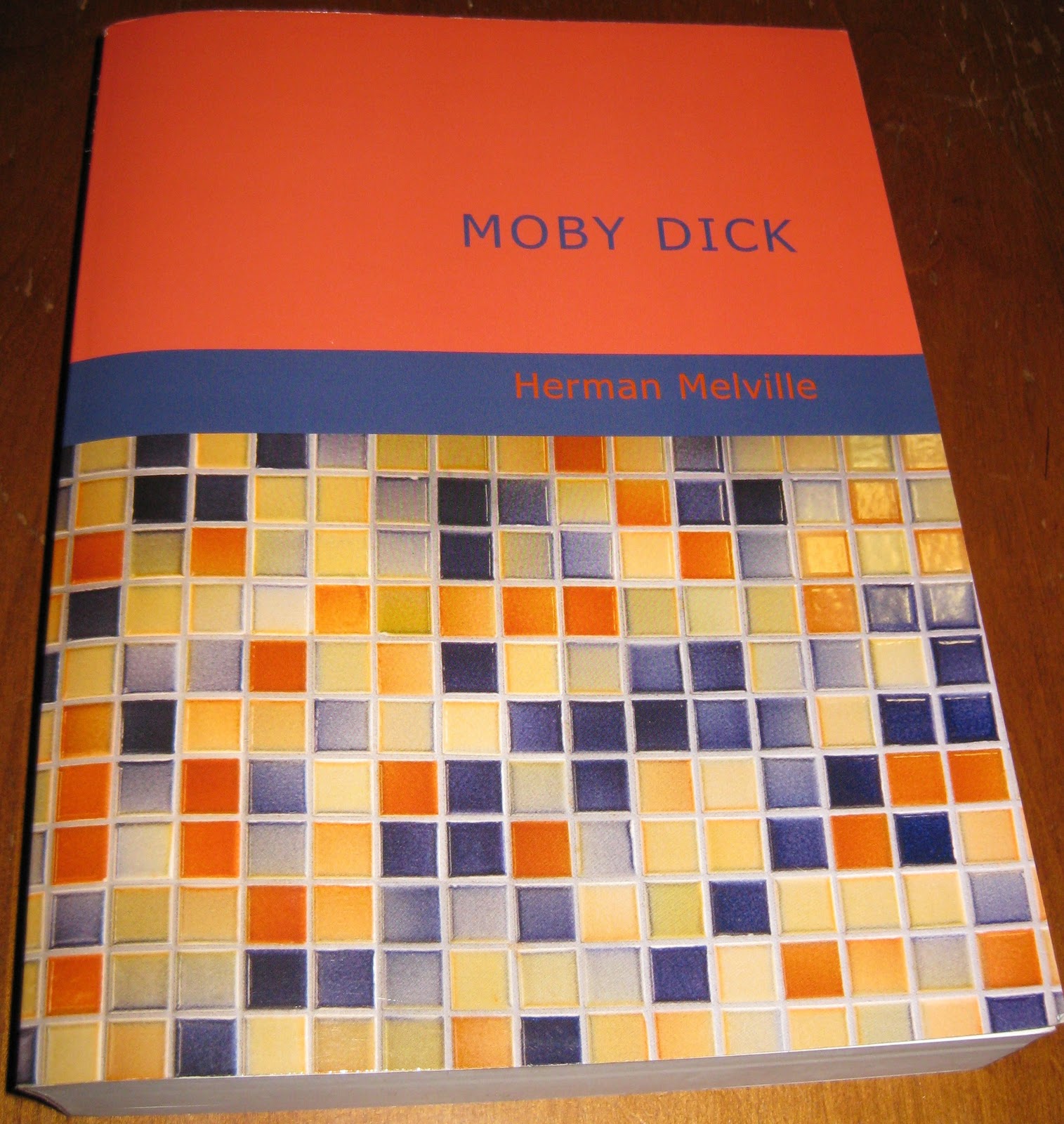
This one is a paperback published by BiblioBazaar.  According to Wikipedia, BiblioBazaar is a division or subsidiary of BiblioLabs LLC.  BiblioLabs is in turn (according to its own website) "a hybrid software-media company, with a focus on using technology to enable curators and subject matter experts to create new works from the wealth of licensed, open source and public domain materials available within our core database." 

Not surprisingly, therefore, BiblioBazaar's large-print Moby-Dick uses one of the uncorrected public-domain texts.  This became apparent to me during the 2011 New Bedford Moby-Dick marathon, when I followed along in this version and began marking ways in which this text appeared to differ from what the readers were saying.

I bought a large-print edition because I wanted one that I could read comfortably at the podium without either stooping over it or holding it up to my face.  This worked well for that, although as mentioned the text is not the most up-to-date.  It's also a heavy one -- too heavy for Gansevoort, I'm sure, but I'm willing to put up with that.  Indeed, the text is so large that I can just keep it open in my lap and follow along with no trouble.

It must be admitted, however, that this is no thing of beauty.  It seems very much like a print-on-demand volume: just the text (with "Etymology" and "Extracts" at the end) and a non-specific cover.

Norton Critical Editions Moby-Dick
Signet Classics Moby-Dick
Penguin English Library Moby-Dick

Tuesday, March 22, 2011

"I like the Nantucketers"

In her 1859 novel The Minister's Wooing, Harriet Beecher Stowe depicts the religious, social, and romantic concerns of the good citizens of Newport, Rhode Island, in the 1790s.  In Chapter XXX ("The Quilting"), she presents a sewing bee, during which some of the young single women discuss marriage.  The topic of a husband's occupation comes up:
Cerinthy Ann contrived to produce an agreeable electric shock by declaring, that, for her part, she never could see into it, how any girl could marry a minister,-- that she should as soon think of setting up housekeeping in a meeting-house.

"Oh, Cerinthy Ann!" exclaimed her mother, "how can you go on so?"

"It's a fact," said the adventurous damsel; "now other men let you have some peace,-- but a minister's always round under your feet."

"So you think, the less you see of a husband, the better?" said one of the ladies.

"Just my views," said Cerinthy, giving a decided snip to her thread with her scissors; "I like the Nantucketers, that go off on four-years' voyages, and leave their wives a clear field.  If ever I get married, I'm going to have one of those fellows."

Saturday, February 26, 2011

Herman Melville Sexual Orientation Watch, Part 2

At the end of her quirky 1996 biography of Melville, Laurie Robertson-Lorant (now a professor at U. Mass., Dartmouth) includes a quirky discussion of Melville's sexuality.  It's short -- three pages -- which is good, because she avoids a sustained argument.

She begins with a fun poke at deconstruction, observing that scholars are "as mesmerized by Paul deMan, Jacques Derrida, Michel Foucault, Luce Irigaray, and Jacques Lacan as Ahab was by Fedallah and his crew of phantoms[.]"  Their politicizing of "[t]he language of sex and gender" is not for her.  She prefers to treat sex and gender as "organic components of complex, changeable human beings."

She then lays it on the line: "In successive drafts of this biography, I have struggled to craft a language for talking about Melville's sexuality without force-fitting him into the Procrustean bed of theory."  She's simply not ready to label him a gay writer.  While she concedes (as anyone must) that "his writings reflect a deep longing for emotional intimacy with other men," we lack evidence of gay sex on Melville's part.  Set Melville beside Whitman, Oscar Wilde, or Charles Warren Stoddard, as she suggests -- the contrast is instructive. 

Melville confuses us because of the upheaval (she uses the French term bouleversement) in his sexual attitudes when he lived in the South Seas.  In the literary world of antebellum America, he was an exotic.  Today, it's easy, probably too easy, to see gayness in the exotics among us.  But we err in applying the same worldly wisdom to Melville.

Robertson-Lorant also tries to contextualize same-sex activities.  Male travelers often shared beds; "erotic tropes" were often used between close friends of the same sex.  She puts the brakes on headlong readings of Melville's heavily scrutinized letters to Hawthorne, which are "more narcissistic than erotic[.]"  And she rightly criticizes the view that Melville must have had gay sex "because all sailors did[.]" 

Melville's fiction was "transgressive" (there's that word again), probing and questioning the pieties of his day.  Reducing that to "Melville was gay" detracts from his artistic achievements and ultimately makes his work less challenging.

Still, we mustn't presume to be definitive.  Yet-undiscovered letters and diaries may wait out there, ready to work a bouleversement in our Melville orientation.  "One never knows what 'great gliding phantom' will emerge from the lost material about, or by, the elusive Herman Melville."

Herman Melville Sexual Orientation Watch, Part 1

Sunday, February 20, 2011

Ipse Dixit: Hershel Parker Has a Blog

Hershel "Mr. Melville" Parker has a blog, begun last month, in which he discusses Melville scholarship, critical reactions to his own work, 19th-century American lit, academic feuds, and related topics.  It's already jam-packed with challenging material.

Don't dawdle here when you could be there: he is mightier than I, whose shoes I am not worthy to bear.

Friday, February 18, 2011

Borders Inventory in 200 Stores Set for Liquidation

Attention shoppers: If you live near one of the 200 Borders bookstores slated for closure, some nice buying opportunities may be coming your way.

As I mentioned in a previous post, Borders filed bankruptcy this past Wednesday and announced plans to close 200 of its 642 stores.  Yesterday, the bankruptcy court approved Borders' sale of the inventories in the marked stores to a consortium of liquidating companies.  What will most likely happen is the liquidating companies (which specialize in this sort of thing) will conduct a store-closing sale at each of the locations condemned to die.  According to the Dow Jones Daily Bankruptcy Review (not available on-line, but many of the source documents can be seen here), Borders will get about 85% of the cost of the inventory plus 50% of the sale proceeds above the 85% mark and certain fixed amounts payable to the liquidating companies.

What does that mean to you and me?  Since time immemorial, retail bookstores have customarily marked up books 100%.  (Or, to put it another way, the "list price" of a book is usually twice what the bookstore pays for it.)  So, if a hardcover book lists for $25, we can assume that it represents a cost to Borders of $12.50.  Actually, the cost might be a bit less than that, because big buyers such as Borders can get better terms from publishers.  In any event, the liquidating companies are paying Borders 85% of its cost, or $10.62 for our hypothetical book.  If the liquidating company then sells the book at a 40% discount ($15), it pays Borders $10.62, pays itself certain selling expenses and fees, and splits whatever is left 50/50 with Borders. 

This can result in some good deals for the patient and lucky.  Years ago, when Encore Books breathed its last, I was able to get a new, unabridged Merriam-Webster's Third (yup, the Big Boy) at half price at our local store.  (They had one copy on the shelves, waiting for the day when some copy editor or word nut would wander in off the street and buy it, I guess.)

Wednesday, February 16, 2011

Borders Files Bankruptcy

Borders Group Inc., the owner of the Borders book superstore chain, filed a chapter 11 petition today in the U.S. Bankruptcy Court for the Southern District of New York.  Chapter 11 enables debtor companies to restructure their debt and equity so that they can (hopefully) avoid total liquidation.  Borders plans to close its underperforming stores, which supposedly amount to about 30% of the total. 

As the Wall Street Journal reports:
In its bankruptcy petition, Borders listed assets of $1.28 billion and liabilities of $1.29 billion as of Dec. 25.

Borders' five largest unsecured creditors are the book publishers Penguin Putnam Inc., Hachette Book Group, Simon & Schuster Inc., Random House and Harper Collins Publishers.
This has not surprised anyone, since Borders had announced that bankruptcy was a strong possibility a month ago.  More information about the case is available here.

UPDATE: The WSJ has posted a handy list of the stores to be closed, sortable by city, state, zip code, and size.  (May be gated.)  Six are listed in Massachusetts, including one on Boylston St. in Boston.

Monday, February 14, 2011

Another Fan Shares His Moby-Dick Collection

Something about Moby-Dick evidently inspires collectors.  One Steve Donoghue shares choice thoughts about, and photos of, eight editions of Moby-Dick at his blog, stevereads, including two I was not previously aware of.  I especially like what he says about the old Signet Classics:
These volumes were put together with rock-solid workmanship and on higher than average quality paper, and the results are visible even in this unthinkable year of 2010: this Moby Dick is a survivor – and if the movies are to be believed, it’ll out-last us all, since it’s this old Signet paperback that’s on the bookshelf of the evil Khan’s makeshift bookshelf in Star Trek II: The Wrath of Khan. And the volume boasts more than superior spine-glue! It’s also got a feisty afterword by Denham Sutcliffe, then of Kenyon College ....
Well worth a visit.

Tuesday, February 8, 2011

Norton Critical Editions Moby-Dick


Norton Critical Editions are familiar to generations of English majors.  They contain "authoritative texts," explanatory footnotes, and generous supplementary material for budding scholars to cut their critical teeth on.  If you're the kind of person who always wants to know more when reading a classic -- what inspired the author, what was going on in his life during the book's creation, how readers and reviewers responded to it in his day -- the Norton Critical Edition will go far toward satisfying your curiosity. 

The publisher of Norton Critical Editions -- W. W. Norton & Company, Inc. -- is a rare bird.  In the publishing industry, where the landscape never rests and the returns on investment rarely climb as high as zero, Norton has managed to remain privately held and (to all appearances) healthy for over 85 years.  It was founded in 1923 as a non-profit, to publish lectures delivered at the adult division of Cooper Union.  (The company's current name comes from one of the founders, William Warder Norton.)  Norton, who was an importer-exporter, soon decided to devote himself full-time to publishing and used his importing know-how to obtain U.S. publication rights to various non-fiction works first published in Europe.  Norton also seemed to have a knack for sniffing out important titles, acquiring rights to, for example, Bertrand Russell's Philosophy and Jose Ortega y Gasset's Revolt of the Masses.  And by 1930, he had begun to tap what would prove to be a lucrative market after World War II: higher education. 

When William Norton died in 1945, his widow sold much of her stock to the company's employees.  The company has been employee-owned ever since.  Reportedly, about 50-60% of the stock, all of which is subject to transfer restrictions, is held by members of its board of directors, and the remainder is held by about half of its 400 employees.

I haven't been able to determine when Norton started putting out its Critical Editions.  The earliest one I've been able to find on Abebooks.com is a Wuthering Heights published in 1963.  As you can see from the linked item, Norton Critical Editions originally had rather plain covers, printed in two colors with no artwork.  (The original cover of the NCE Moby-Dick, first published in 1967, can be seen at Mr. Pettit's blog.) 

The Norton Critical Edition of Moby-Dick is now in its second edition.  Pictured above on the left is the first, 1967 edition, with the last cover it had.  On the right is the second edition, which came out in 2001 (hence the "150th Anniversary" banner dimly visible running across the upper right corner of the cover). 

As you can see, the second edition is slightly taller and wider than the first, with a splashier cover.  It contains far more explanatory footnotes than the first edition (which had always struck me as very stingy in the footnote department).  They've kept most of the supplementary material -- including the crudely but effectively illustrated discussion of how whaling was done -- and they've added a good deal of new matter.  Most notable among the new additions are a short essay on Melville's reading, about 50 pages of source material on how Melville was viewed before the appearance of Moby-Dick, and an essay on "the grim effects" that Moby-Dick had on Melville's later career.  In addition, several of the critical excerpts have been switched out for different entries.

But wait, shipmates.  All is not as it should be.  Sadly, the editors decided to jettison from the second edition one of the first's most useful (and most scholarly) features: the lists of variant readings.  The first edition contained 28 pages detailing the textual differences between the first English and American editions, and textual emendations that the scholar-editors (Harrison Hayford and Hershel "Mr. Melville" Parker) determined were needed.   Thus, the serious reader could find out the sources of differences in wording among the various versions in print and rule out (or not) mere modern typos.  Now, it is true, as the second edition's Preface explains, that the publication of the Northwestern-Newberry edition of Moby-Dick, detailing textual variants, made inclusion of a similar section in the NCE duplicative.  But why make purchase of an additional volume necessary? 

As so often happens, the new does not surpass the old.  By all means, buy the second edition.  But don't discard the first.

Earlier entries in this series:

Signet Classics edition

Penguin English Library edition

Penguin English Library Moby-Dick

Penguin Edition of Moby-Dick
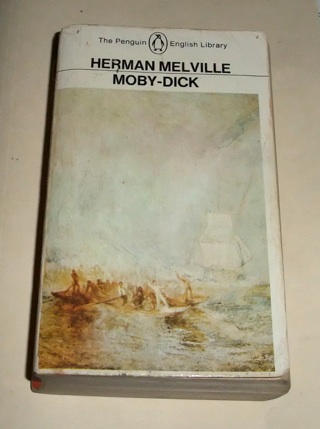
In contrast to Lemuel, with his Signet Classics copy, I didn't seriously attack Moby-Dick until August, 1983. On my first trip to Europe, cycling out of Paris, I wanted something substantial to read to pass the evening hours in my tent. My Junior-year English prof had always touted M-D as "the great American novel," so an English-language edition became my monomaniac thought. (Pity I didn't think of it before leaving cosmopolitan Paris.) A few small-city bookshops had no romans en anglais -- it wasn't until reaching Dijon that it was sighted, in the grand Librairie de l'Université. The shop clerk understood my execrable French (she pronounced it "mo-BEE-dick," I recall), and 42.50 francs (about $5.50 in '83) later I walked out with the object of my quest; noted in my journal: it felt like Christmas morning.
The book is a log, with about half as many pages of ancillary material as there are of the novel itself, but the weight and space it took in my pannier wasn't any concern. I pedaled with it for three months; read it in bars and parks, in hostels and campgrounds; even visited the Heidelberg Tun described in Chapter LXXVII. It was my text at three Moby-Dick marathons, now retired in favor of a sturdy hard-cover copy with larger type (a gift from Lemuel).
'83 Tour MascotI still consider it an excellent edition. The editor, Harold Beaver, is described as "Reader in American Literature at the University of Warwick." It appears that he wanted to put everything needed to appreciate M-D in a single paperback package, with a dream-like Turner painting on the cover. (I only just now realized that it includes Chase's The Wreck of the Whaleship Essex; Lecomte's Le Cachelot Blanc, in French and English; and Mocha Dick from The Knickerbocker magazine!) There are the usual biography and history-of-composition, with a very useful and readable "Introduction" (more on that in another post). In classy-academic Penguin tradition, there are thorough notes on the differences between the first English and American printings. And in the middle of it all, right where the binding cracks, are eight pages of photographs -- period prints and paintings, a New Bedford whaleship, a gold doubloon, the Bethel, and a mummified Maori head (my mental mascot that summer).
For that first "committed" reading, Beaver's "Commentary" section was my private tutor, greatly increasing my understanding and appreciation of Melville's labors. There is about one page of notes for every two pages of source text. References to the Bible, Milton, Shakespeare, Carlyle, etc. are elucidated. Internal references are tied together. Symbolism is discussed. Technical terms are described. (E.g., what are the carlines?)
I'm not sure if this all-in-one edition is still in print, or if it was ever distributed in the U.S. This book has the same IBSN, mentions Beaver, and lists about the same number of pages.
Look for the shrunken head on the first page of photos -- accept no substitutes!

Sunday, February 6, 2011

Melville and Carlyle

One hundred and thirty years ago yesterday, Thomas Carlyle died in London.  Although he is little read today outside academia, it's hard to overestimate his influence on English and American writers in the 19th century.  If you rolled David McCullough, Truman Capote, and George Will into one, you might have a writer approaching Carlyle's standing.

An insatiable reader like Melville could not have gone long without crossing Carlyle's path.  We learn from Hershel Parker ("Mr. Melville") that Melville borrowed two of Carlyle's early books, Sartor Resartus (1836) and Heroes and Hero-Worship (1841), from Evert Duykinck in mid-1850.  His reading of Sartor Resartus at this time may be especially significant, because in it Carlyle exercised a dark sense of humor, an experimentation with genre boundaries, and an intense penetration of the surfaces of things that must have appealed strongly to Melville.  What, for example, could be more Melvillean than Carlyle's epitaph for a fictitious German nobleman (given in Latin in Book II, Chapter IV, of Sartor):

Here lies 
Philip Zaehdarm, known as "the Great," 
Count of Zaehdarm, 
of the Imperial Council,
a Knight of the Golden Fleece, of the Garter, and even of the Black Vulture.
Who, while he lived under the moon,
shot five thousand partridges;
and converted directly into manure
one hundred million hundredweight
of various foods,
on his own and through his servants, quadruped and biped,
not without descending into commotion.
His works follow him,
now at rest from his labor.
If you seek his monument,
look at this big pile of dung.
He deposited it on the earth first on [fill in date]; and last on [fill in date].

Saturday, February 5, 2011

One Man's Obsession with an Obsession

Thanks to Iron-bound Bucket, here's a rare book room of a site that chronicles the Moby-Dick collection of one W. O. Pettit, of Albany (an appropriate place for a Melville collector if ever there was one).  Mr. Pettit's holdings are lovingly described and photographed (inside and out), and searchable by decade.