The New Bedford Whaling Museum's Moby-Dick Marathon is an annual non-stop reading of Herman Melville's literary masterpiece. The multi-day program of entertaining activities and events is presented every January. Admission to the Marathon is free.
Showing posts with label Ahab. Show all posts

Sunday, March 4, 2018

Ahab, the Old Man

Herman Melville, around age 66

"God, God is against thee, old man; forbear!"

A persistent criticism of director John Huston's 1956 Moby Dick is that Gregory Peck was too young to play Captain Ahab.  Born in 1916, Peck was about 40 when the film was released -- more than ten years younger than Leo Genn, the actor who played Starbuck.  As some pointed out, it would have made more sense if Peck and Genn had switched roles.  Genn, however, while an accomplished British film actor with a splendid voice, had no star power.

A few remarks by Ahab in Chapter 132 ("The Symphony") enable the reader to pinpoint his age at the end of the novel's action as 58.  Ahab there tells Starbuck that he struck his first whale 40 years earlier, as "a boy-harpooneer of eighteen!"  But Ahab's all-around agedness is noted throughout the novel.  He is, among other things, a "scornful old man," "the queerest old man," a "monomaniac old man," an "ungodly old man," an "insane old man," a "wondrous old man," a "frantic old man," a "crazed old man."

(Others aboard the Pequod described as "old men" are the blacksmith, the cook, and most intriguingly, Fedallah (in Ch. 48).)

To Melville, who (mirabile dictu) was in his very early 30s while writing Moby-Dick, 58 must have seemed quite old.  To me, who hit 58 recently, it doesn't seem old at all.  Granted, I'm a landsman, "pent up in lath and plaster," not running around a ship on a peg leg and throwing lances at sperm whales.  Moreover, 58 was indeed old for a whaling captain.  The authors of In Pursuit of Leviathan gathered age data for 275 whaling voyages out of New Bedford between 1842 and 1858.  The oldest recorded man on any of those voyages was 62, and only 12 men were over 50.  (See the tables on pp. 94-96.)  As the authors point out (p. 90), "on 50 percent of the voyages for which we have [New Bedford] Port Society lists, the oldest man aboard was thirty-five or younger."  (Emphasis added.)

The significance of Ahab's being an old man has been much discussed.  From a purely practical standpoint, it helps make more believable that Ahab could bend the entire crew to his will, notwithstanding repeated bad omens and his occasionally dotty behavior.  The reader has to be willing to accept that even the intrepid whale-hunter Starbuck could not withstand the "spiritual terrors" that menaced him "from the concentrating brow" of the "enraged and mighty man."  (Ch. 26.)

Sunday, January 25, 2015

Captain Ahab and Admiral Nelson

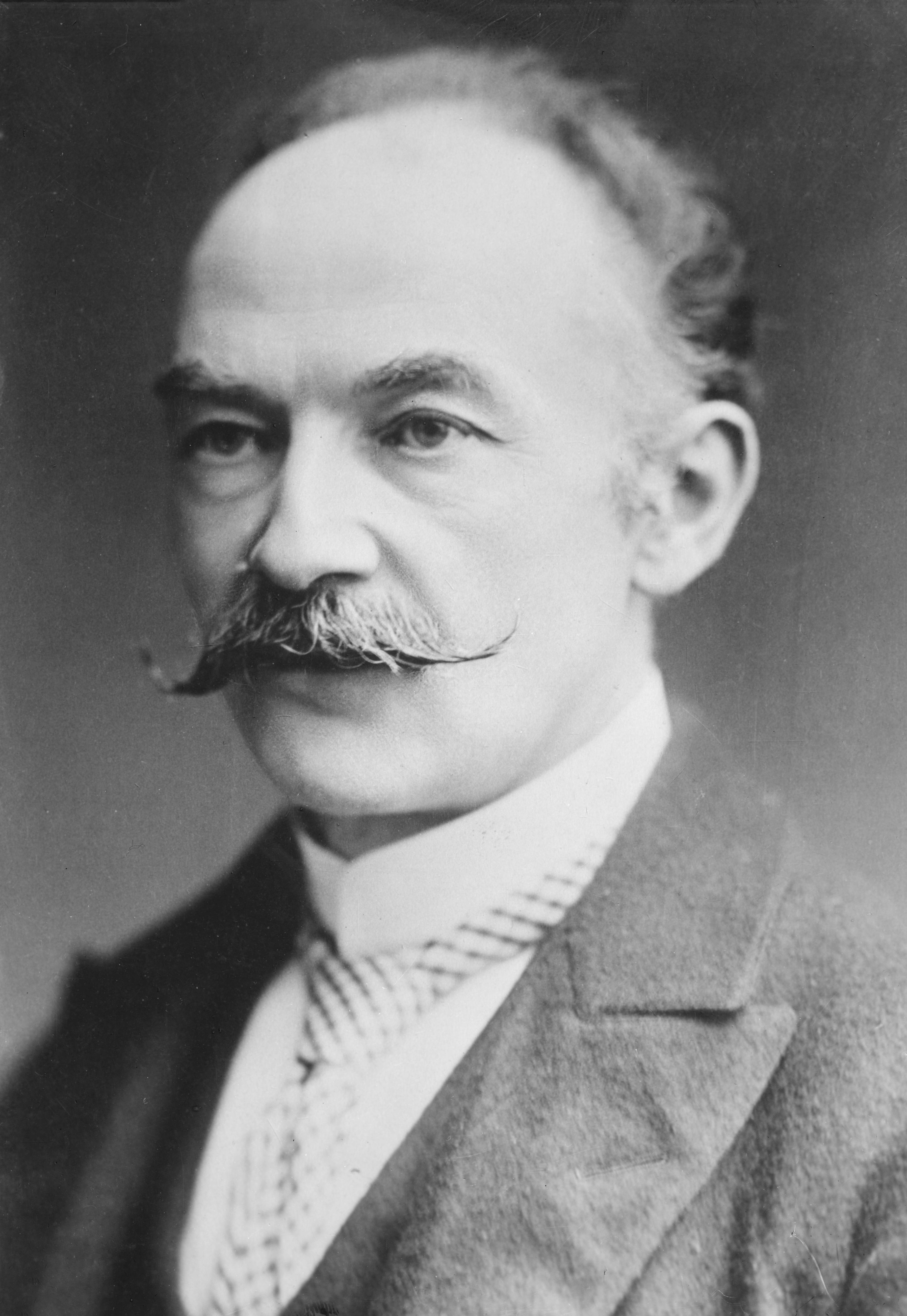
Thomas Hardy (Bain News
Service, publisher, public
domain, via Wikimedia
Commons)
The Dynasts is a three-volume epic poem (in the form of a drama that could never be staged) by Thomas Hardy (1840-1928).  Published between 1904 and 1908, it depicts the Napoleonic Wars through the actions of heads of state, generals and admirals, and the man in the street, with framing commentary by various "shades" and "spirits" that observe humanity.

My cursory research has not turned up any evidence that Hardy read or was aware of Moby-Dick.  (The Oxford Reader's Companion to Hardy [2000], for example, contains no entry for either Melville or Moby-Dick.)  All the same, in volume one of The Dynasts—in Part First, Act Fifth, Scene IV, to be exact—Hardy puts a very Ahab-like speech in the mouth of Admiral Nelson.  In the scene, set aboard the Victory at the battle of Trafalgar, Nelson lies dying from a gun shot to his spine.  He gives the order "to anchor" to the officers standing nearby, and one officer asks him if he wishes Admiral Collingwood to be instructed to "take full on him the conduct of affairs."  Nelson says no, that he will continue in command himself:
Give Collingwood my order.  Anchor all. 
... By God, if but our carpenter
Could rig me up a jury-backbone now,
To last one hour—until the battle's done,
I'd see to it!  But here I am—stove in—
Broken—all logged and done for!  Done, ay done!
By way of comparison, here's a taste of Ahab:
Carpenter, when he's through with that buckle, tell him [the blacksmith] to forge a pair of steel shoulder-blades; there's a pedlar aboard with a crushing pack. ... 
Hold; while Prometheus is about it, I'll order a complete man after a desirable pattern. Imprimis, fifty feet high in his socks; then, chest modelled after the Thames Tunnel; then, legs with roots to 'em, to stay in one place; then, arms three feet through the wrist; no heart at all, brass forehead, and about a quarter of an acre of fine brains; and let me see—shall I order eyes to see outwards? No, but put a sky-light on top of his head to illuminate inwards. There, take the order, and away.
(From Chapter CVIII, "Ahab and the Carpenter.")


Wednesday, April 13, 2011

On Beckett's birthday

Samuel BeckettSamuel Beckett born April 13, 1906.
Was there one among them to put himself in my place, to feel how removed I was then from him I seemed to be, and in that remove what strain, as of hawsers about to snap? It's possible. Yes, I was straining towards those spurious deeps, their lying promise of gravity and peace, from all my old poisons I struggled towards them, safely bound.
- Molloy

I feel strained, half stranded, as ropes that tow dismasted frigates in a gale; and I may look so. But ere I break, ye'll hear me crack; and till ye hear that, know that Ahab's hawser tows his purpose yet.
- Chapter CXXXIV

Monday, January 17, 2011

Why "Ahab Beckons" (Gansevoort's view)

Gregory's grimace[See Lemuel's previous post on this topic.]

As Patti Smith told an interviewer who asked why she wore those strange clothes, "It looks cool."

As Lemuel suggests, confusion over the phrase "Ahab beckons," invented for a not-aimed-at-the-literati Gregory Peck period-revenge thriller (viewable online), shows how much a part of our culture Melville's original work has become. (Although I was shocked last month to find that my friend's college-junior daughter had never heard of the book or the movie. "What's Moby Dick?" A teachable moment, I guess.) Should we view Ray Bradbury's script as a mashup? (Doesn't that term sound quaint?)

Nor should we bookish types be smug. The prow-shaped pulpit in the Seamen's Bethel to which we troop for the reading of the "Father Mapple" chapters was only installed in 1961, in response to visitors' expectations after having seen the movie. (When the legend becomes fact, print the legend.)

Me, I'm a fatalist who loves a jolly memento mori.
Remember me as you pass by,
As you are now, so once was I,
As I am now, so you will be,
Prepare for death and follow me.
And I love the complete quote from the movie: Ahab beckons. He's dead but he beckons. It calls to mind a favorite phrase from Samuel Beckett's The Unnamable: ...the ancient dead and the dead yet unborn...

But why say more? Ahab beckons each of us readers. Even Ishmael's story had its end.

Speaking of Beckett, here's another bit from The Unnamable that could have been in the mind of any of the Pequod's crew (as it was often in the mind of a certain corporate wage-slave, also on a rather long lay):
I, who might that be? The galley-man, bound for the Pillars of Hercules, who drops his sweep under cover of night and crawls between the thwarts, towards the rising sun, unseen by the guard, praying for storm.
Morning to ye, shipmates, morning; the ineffable heavens bless ye...

Why "Ahab Beckons"?

As any Melville aficionado can tell you, the phrase "Ahab beckons" appears nowhere in Moby-Dick.  It's one of Ray Bradbury's inspirations, added to the story when he wrote the screenplay for John Huston's 1956 Moby-Dick.

WARNING: SPOILERS AHEAD

In the 1956 film, the line "Ahab beckons" is spoken by Stubb (Harry Andrews), during the final chase of Moby Dick.  Prior to this line, Ahab is knocked from his whaleboat, grabs the ropes streaming from Moby Dick to pull himself onto the whale's back, stabs the whale with a dangling harpoon while shouting two phrases taken verbatim from the book ("from hell's heart I stab at thee; for hate's sake I spit my last breath at thee"), and then becomes entangled in the ropes and drowns while bound to the whale's body.  The three mates then see Moby Dick swim by, with Ahab's corpse plastered to his side, Ahab's dead arm flopping back and forth as the whale rolls.  Hence, Ahab "beckons" to the sailors to follow him.

This makes for memorable cinema, but it bears little resemblance to what happens in the book.  In the book, Fedallah (whom Bradbury excised in writing his version) is the one whose corpse the sailors (and Ahab) see lashed to Moby Dick's side.  And there is no beckoning, even by Fedallah.  His fate is instead tied by Ahab to a prophecy Fedallah had made ("Aye, Parsee! I see thee again," Ahab says. "Aye, and thou goest before; and this, THIS then is the hearse that thou didst promise.").   What Bradbury apparently did was take bits of the Fedallah storyline and work it into his streamlined version, adding the visual touch of Ahab's waving arm. 

Admittedly, an entirely faithful filming of Ahab's death would be quite underwhelming, since Ahab is jerked from this world in the blink of an eye ("voicelessly as Turkish mutes bowstring their victim, he was shot out of the boat, ere the crew knew he was gone"). 

END OF SPOILERS

So why would we title a blog devoted to the annual New Bedford Moby-Dick marathon with a movie line that has no analogue in the book itself?  Gansevoort came up with the idea; I can't speak for his thinking.  For myself, among other reasons, I think it reflects the gap between text and audience.  Moby-Dick, more than other classics, demonstrates that a literary creation does not come with its own readership.  Rather, it's at the mercy of the world it's launched into.  Moby-Dick found a publisher, luckily, on the strength of Melville's earlier works, but it nearly sank like a stone on its first appearance.  Some 50 years later, it was discovered and finally appreciated.  It now remains a living classic, with real, non-academic readers, thanks partly to movies, the New Bedford Whaling Museum, and the museum's marathon.