The New Bedford Whaling Museum's Moby-Dick Marathon is an annual non-stop reading of Herman Melville's literary masterpiece. The multi-day program of entertaining activities and events is presented every January. Admission to the Marathon is free.
Showing posts with label Moby-Dick. Show all posts

Wednesday, March 25, 2020

In your "insular Tahiti"...

These recordings of M-D could ease the monotony of isolation. All are available as free, downloadable .mp3 files. So load up your audio device of choice for those home-bound sessions of low-impact aerobics.
  • Both Librivox and Project Gutenberg offer the same reading by Stewart Wills. He's a good, clear speaker, not overly dramatic. Slightly annoying is the 15-second intro to each file: "This is a Librivox recording, ..." There are 44 .mp3 files, including Etymology and Extracts. The Librivox site lets you download all the recordings in a single .zip file (677 MB); on the Gutenberg site, you can only download each file separately. (Scroll down the Gutenberg page to see the files in .mp3 format.)
  • The recordings of the Moby Dick Big Read were posted in weekly installments back in 2013 (and duly reviewed). The drivers of this project, Angela Cockayne and Philip Hoare, recruited as readers prominent actors, authors, and artists; as well as TV/radio hosts, scientists, sailors, students, and a Prime Minister. The voices are varied, and nearly all the readings are top-notch. (Tilda Swinton reading Loomings is refreshingly unexpected.) You have to download each of the 136 chapters separately (no Etymology or Extracts), via the "down arrow" icon at the top-right corner of the player.
One caveat: All of these readings are from some copy of M-D that does not include the corrections made (by Hayford, Parker, and Tanselle) for the 1988 Northwestern-Newberry edition (discussed previously).

Photo: Wikimedia Commons

Monday, December 2, 2019

Latest News from the Feejees - 11

It had to happen...


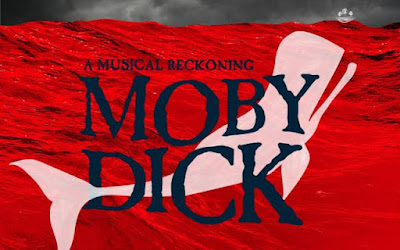
https://americanrepertorytheater.org/shows-events/moby-dick/

Enjoying its world premiere in Cambridge, MA, through January 12.

Make sense who may. I switch off.       - What Where

Wednesday, May 23, 2018

Latest News from the Feejees - 10

50,000,000 Shades of Grey fans can't be wrong...

Edited 10/23/2018 to add final votes.
MDM regulars will recognize Mary K. Bercaw Edwards, making the case for Moby-Dick as the "best-loved book" in The Great American Read on PBS. An experienced sailor, Melville scholar, and a pillar of MDMs at the Whaling Museum and Mystic Seaport, Ms. Bercaw Edwards knows whereof she speaks.

The 2-hour broadcast can be streamed on the program's home page. Skip to time 56:00 to hear why M-D is that fabled "great American novel."

It would be petty to gripe that this whole "list & vote" thing is a meaningless popularity contest skewed by the whims of ill-informed adolescents and political/religious zealots, so let's ignore that. No "Top x" list can satisfy everyone. (Where the dickens is Joyce's Ulysses?) Still, taken for what it is, this list might point you to a good read, and might point some wanderer to Moby-Dick.
10/23/18 - This just in: Moby-Dick ranked as #46 (higher than I would have predicted).
To Kill a Mockingbird was voted #1.

Tuesday, March 13, 2018

Melville and the Iron Duke

Wellington (detail), painted soon after Waterloo

The Duke of Wellington, who led the allied forces to victory over Napoleon at the battle of Waterloo, famously declared to his troops at the decisive moment, "Up, Guards, and at 'em!"  While historians have long doubted he actually said that (Wellington himself couldn't remember what he may have said), the command attributed to him seems to have been as familiar to nineteenth-century English speakers as "a date which will live in infamy" is to us today. 

A quick search on Google Books has turned up a pre-Moby-Dick reference to the saying in a New York periodical:  The June 1846 issue of The Eclectic Magazine of Foreign Literature, Science, and Art reprinted from Punch a humorous exchange of letters in which one Adolphus Carns tried to have the Duke settle a bet over whether he had said, "Up, Guards, and at 'em," or "Guards, up, and at 'em!"   Wellington declined to decide the dispute.

What does all this have to do with Melville?  Scholars have shown how Melville's writing in Moby-Dick echoes Shakespeare frequently and, less often, other authors he was reading at the time.  And something that sounds a lot like an echo of Wellington comes from the mouth of the Tahitian Sailor in "Midnight, Forecastle" (Ch. 40): "The blast! the blast! Up, spine, and meet it!"

Incidentally, in what might be called the battle-of-Waterloo section of Part I of Finnegans Wake, Joyce plays with the command attributed to Wellington (amid references to the Sepoy Mutiny of 1857 and Alice's Adventures in Wonderland and who knows what else):  "This is the seeboy, madrashattaras, upjump and pumpim, cry to the Willingdone."

Friday, October 31, 2014

Latest News from the Feejees - 9

photo by Bill Ebbesen

What's on Bruce's night stand?


Moby-Dick, of course! From an interview in yesterday's New York Times:
I just finished “Moby-Dick,” which scared me off for a long time due to the hype of its difficulty. I found it to be a beautiful boy’s adventure story and not that difficult to read. ...
Make sense who may.

Wednesday, July 2, 2014

Latest News from the Feejees - 8

Ron Howard 2011 Shankbone 3
In his talk yesterday at the Morgan Homecoming, Fred Calabretta of Mystic Seaport mentioned that Ron Howard is completing a film of In the Heart of the Sea, Nathaniel Philbrick's retelling of the the sinking of whaleship Essex ("#1 Best Seller in Ship History" on Amazon). This has been public knowledge for a couple of years, but it was news to this blog.

imdb.com has a page with all the info. The U.S. release date is 13 March 2015. With direction by Ron Howard, it's sure to be a polished production that will put the posteriors in the seats, as they say. Will this high-profile film attract a crush of folks to MDM20 in January, 2016? I'm sure the wheels of preparation are in motion at the Whaling Museum.

Slightly related: A film version of Bill Bryson's A Walk in the Woods is scheduled for release in 2015/16. The Appalachian Long-Distance Hiker's Association is already discussing ways to aid/educate the clueless hordes that will hit the trail in the years following.

Tuesday, January 14, 2014

Saturday, December 14, 2013

Gift idea?


The Moby Dick Card Game is another Kickstarter project. It was fully funded, and the first run has shipped. The artwork looks terrific, but the game is unavailable to the general public at present.
Even without a knowledge of the novel, playing the game will clue you into the relationships between key sailors and the various perils and processes of hunting whales in the 19th century.
As important as the visuals are, the game could not exist without Melville's voice. Every card features a choice quotation from the book, tying the action at hand to the grand tale itself.
Keep an eye on their Facebook page and their website—they promise a webstore soon.

Hat tip: Kiwi.

Wednesday, December 11, 2013

Gift idea?


Emoji Dick is a crowd sourced and crowd funded translation of Herman Melville's Moby Dick into Japanese emoticons called emoji.

It's a free country. I can't help but agree with one commenter, "That's astoundingly useless."


Hat-tip to techie Megan.

Saturday, November 16, 2013

Did Proust Read Moby-Dick?

One hundred years ago today, on November 16, 1913, the first volume of Proust's In Search of Lost Time was published. Like our beloved Moby-Dick, it has since come to be recognized as one-of-those-works-you-should-read-before-you-die.

At seven volumes and about 1.5 million words, it dwarfs M-D (about 209,000 words). Students complain about M-D's Cetology chapter—Temps Perdu seems to carry Melville's "detail-oriented" approach beyond the limits of human endurance! So I have to wonder, did Proust read Moby-Dick? Was Melville an influence on "the major novel of the twentieth century" (Harold Bloom)?

Looks like probably not. According to Critical Synoptics: Menippean Satire and the Analysis of Intellectual Mythology by Carter Kaplan, "The first French translation of Moby-Dick was not published until 1941." That's nineteen years after Proust's death. So unless Proust was an accomplished reader of English, there's no way. Alas, a review of  Proust's English (2005) in the New Yorker states:
Proust did not speak English, and read it only with difficulty (though he translated Ruskin, with much help from others).
It appears (according to Wikipedia) that Proust's influences were of the "old world": Saint-Simon, Montaigne, Stendhal, Flaubert, George Eliot, Fyodor Dostoevsky, and Leo Tolstoy.

Regarding another favorite "detail-oriented" novel, the question arises: Could Joyce's Ulysses have been influenced by Moby-Dick, or by Temps Perdu?

Wednesday, October 30, 2013

M-D Opera -- on TV & at MDM18

Moby-Dick, the opera, will be broadcast on Boston's PBS station, WGBH, four times in the next week, as part of the Great Performances series. Check your local listings, as they say, but for Boson-area folks it's:
  • Friday, Nov. 1, 9 PM, channel 2
  • Saturday, Nov. 2, 2 AM, channel 44
  • Sunday, Nov. 3, 1:30 PM, channel 2
  • Monday, Nov. 4, 3 AM, channel 44
If you plan to attend the Marathon's kick-off lecture on Jan. 3 (2014), you'll want to check out this opera. The featured speaker will be its librettist, Gene Scheer.

Wednesday, October 2, 2013

No NYC M-D Marathon this year

Brooklyn's Word bookstore, which organized last November's "1st ever NYC marathon-style reading of Herman Melville's Moby-Dick," announced that the reading will be "on hiatus" this year. A second NYC marathon is scheduled for November 14-16, 2014.

For 2013, Word will "celebrate Melville and his leviathanic masterpiece" with an evening of "readings, screenings, performances, sing-a-longs, and more" on November 15 at 7 P.M.

Thursday, July 11, 2013

The Symphony (and Cantata)

photo: Vancouver 125
As a film (and film score) buff, I eagerly followed up on Lemuel's discovery that Bernard Herrmann had written a Moby Dick cantata and sinfonietta.

For those less obsessed, Bernard Herrmann composed for some of the greatest films of the 20th century (Citizen Kane, The Magnificent Ambersons, Taxi Driver, ...), finding particular success writing for Alfred Hitchcock (Vertigo, North by Northwest, Psycho, ...).

Herrmann wrote two pieces inspired by M-D. The Sinfonietta, written for string orchestra in 1935-36, and the Cantata, written for male voices and orchestra in 1936-38. You can hear snippets of a CD by the Danish National Symphony Orchestra on this Amazon page. According to the liner notes:
The fondness which the composer held for Melville's Moby Dick [sic] dated from his boyhood. The novel was a childhood favourite and as a young man Herrmann's father had served on two whaling ships and was even shipwrecked on an island in the Bering Sea in 1892.
Apparently, Herrmann originally intended to write a M-D opera, and had discussed it with lyricist William Clark Harrington. Harrington was "a New England poet and manager of the CBS music library." Together they took trips to the novel's Massachusetts locations, searching for inspiration. In the end, the opera became the cantata, with "text selected and arranged from the novel" by Harrington. Interestingly, the canata is dedicated to Herrmann's friend, Charles Ives.

If you have any interest in M-D spin-offs and/or orchestral music, seek out this recording. It bears close listening. The Sinfonietta is the culmination of Herrmann's interest in Arnold Schoenberg (say the liner notes). The Cantata condenses the novel to 45 minutes, featuring solos by Ishmael, Ahab, Pip, Starbuck, and various generic "sailors."

One curiosity: You can hear in the Amazon clip for track 10, Ahab sings "...and hemp can only kill me." M-D devotees will realize this is a misquote of "...and hemp only can kill me." The libretto with the CD has the same error.

Now, the singer for this recording is British, a native English-speaker, David Wilson-Johnson. One might assume he would have recognized that "can only kill" doesn't make sense in this context. Either there was an error preparing the CD, or Herrmann & Harrington made the error. I'd bet the former. It's a question for the Bernard Herrmann Society. (Yes, there is one!)

[Whoa! I completely forgot that I blogged about this music back in 2011. Time to listen to Old & In The Way.]

Thursday, February 7, 2013

...proceed to put on lasting record

photo: happykatie
The Moby-Dick Big Read has concluded. After posting a chapter each day since September, all 136 chapters are now available for free download as MP3 files. The complete reading will take about 2.5 GB on your iPod. Grab them now — there's no telling how long they'll be up.

The readings range from adequate (Does a life at sea really reduce one's voice to a Tom Waits growl? Ahab impersonators seem to think so.) to entertaining to incantatory.

Readers include M-D-related authors (Nathaniel Philbrick, Andrew Delbanco), Masterpiece-Theatre-caliber actors (Tilda Swinton, Stephen Fry, Benedict Cumberbatch), and the odd UK Prime Minister.

Apparently, many of the readers are well-known in the UK. This blog by M-D virgin and reader-with-lovely-accent, Eva Stalker, gives the credentials of most of them.

If you listen to just one...

One reading stood out for me, for its inspired match of reader and text. Chapter 105, Does the Whale's Magnitude Diminish? — Will He Perish?, is read by veteran natural-history documentarian David Attenborough. His voice and delivery are immediately recognizable, and make our time-honored text as fresh as this week's installment of Nature.

Friday, January 18, 2013

M-D Marathon in Liverpool

Still trying to find the time/fortitude to post a summary of MDM17, this just in:

Moby-Dick on the Mersey

May 4-6, 2013
Merseyside Maritime Museum
Liverpool, England
The event website says this will be the "first ever Moby Dick [sic] marathon reading," with a reader for each chapter. [Here's hoping they get a good one for The Town-Ho's Story!]

There's a bit on Melville's Liverpool connection in this post.

[Hat-tip to Wyn Kelley]

Tuesday, November 27, 2012

Reports from the NYC "Marathon"

Credit: Postdlf at the English language Wikipedia
Family commitments kept me from the "1st Ever NYC Marathon-Style Reading" of M-D, but here are two post-mortems: one from the N.Y. Daily News, and another from the "online news magazine," Capital.

From these reports we get a glimpse of the effect of location on the character of a M-D marathon. It seems the NY event was more self-conscious (and celebrity-aware) than the New Bedford event, with audience members and readers (!) freely commenting peanut-gallery-style — something that is all but unthinkable at our marathon. This difference may be, as Lemuel posited in a previous post, a result of vestigial "Calvinist mind-habits" among New Englanders.

One striking detail: the NY audience felt free to bring cans of beer, and to open them audibly during the reading. I doubt the Whaling Museum staff, or audience, would tolerate such a breach of decorum. (I have heard that alcoholic grog was available at the New Bedford marathon in its early years, until too many locals began coming just for the "party.")

Organizers intend to make the NY reading an annual event. Next year's is scheduled for November 15-17.

Thursday, October 18, 2012

Google's Homage

Today's background image at google.com
Google today remembers the publication of M-D (in London, 161 years ago) with the above background image on its search page.

Another hat-tip to brother #3, T. (I've abandoned Google for duckduckgo.com!)

Wednesday, October 10, 2012

Moby-Dick Marathon in NYC!

If you can't wait for January's (preeminent) M-D marathon in New Bedford, there will be a "marathon-style" reading in New York City next month.

Broken into four sessions over the course of three days, it will start Friday, November 16 at 5 P.M. at Word bookstore in Brooklyn.

Details are being released on mobydickmarathonnyc.org.  It appears that readers ("crew" in this marathon's parlance) were recruited from NYC's community of writers and "book people." Sarah Vowell was the only name I recognized immediately (from her days on This American Life).  Searching on some of the more distinctive names revealed details:
I'm interested to hear what these representatives of the literary world of NYC, arguably the world's current art omphalos, bring to our treasured text.

Hat-tip to brother #3, T.

Tuesday, October 2, 2012

Chapter-a-day audio streams

Prime yourself for MDM17 with a chapter-a-day streamed to your PC or downloaded to your MP3 player. (These readings are worth saving.)

The Moby Dick Big Read includes as readers some big names from British film and theater, such as Tilda Swinton, Simon Callow, Stephen Fry—and they're only up to Chapter 16!


Hat-tip to Henry Ferrini (filmmaker behind Polis is This, which interprets the work of Charles Olson).

Saturday, April 28, 2012

Melville is the one that should keep novelists up at night

A segment in last Friday's broadcast of On the Media (20 Apr 12) caught my ear. In it, writer Tom Bissell recounts how "random events can rule the destinies of the greatest works of art."

The works of Franz Kafka, Walt Whitman, Emily Dickinson, and our Herman might have been forgotten, even lost, but for something as arbitrary as a particular person wandering into a used book store.

Melville is the one that I think should keep novelists up at night.

Bissell tells how Moby-Dick was "a resounding un-success" when first published, selling "three thousand copies over its thrity-six years in print." (Does that count sales in England?) By the turn of the 20th Century it was unpublished and unread. Sometime in the early 1900's, "according to the legend," critic Carl Van Doren found a copy of M-D in a used book store, recognized it as a masterwork, and wrote about it. A Melville renaissance followed — his books were brought back into print and have stayed in print since.

The essay that started it all was gathered into Van Doren's study, The American Novel, published in 1921, with a second edition in 1940. Copyright on the 1921 edition has expired; you can find it online.

If you're interested in the current state of the publishing business as it confronts e-readers, copyright extensions, Amazon's under-pricing, and knock-off books (such as "I Am the Girl with the Dragon Tattoo," not by Stieg Larsson), listen to the entire program.