The New Bedford Whaling Museum's Moby-Dick Marathon is an annual non-stop reading of Herman Melville's literary masterpiece. The multi-day program of entertaining activities and events is presented every January. Admission to the Marathon is free.

Thursday, February 16, 2012

The 16th New Bedford Moby-Dick Marathon -- Scholar "Chats"

photo: Metro Library and Archive
For the second year in a row, the Marathon offered "Chat with a Melville Scholar." The scholars were available in a side-gallery, for two hours Saturday afternoon and one hour Sunday morning. I imagined this as sort of a visit to the library's reference desk — you ask your question, get your answer, and move on — but it turned out to be much more.

On Saturday I walked in on scholars Wyn Kelley (M.I.T.) and Timothy Marr (UNC), engaged in a free-form discussion with a small knot of marathoners. Ms. Kelley called me over to join the group. Other marathoners, as well as scholars Mary K. Bercaw Edwards (U. of Conn.) and Chris Sten (George Washington U.), wandered in until the circle swelled to over twenty.

There followed a sort of Master Class on "Moby-Dick and other matters arising," with insights voiced from all quarters. Among the "audience" were several students of literature, and a number of amateurs who clearly had given M-D a lot of thought. (Marathoners are fascinating people.)

Scribbling notes as fast as I could, I walked away with "leads" that could occupy this Melville dilettante for months:
  • The Art of Fielding; fiction, somehow relevant
  • seek out Lisa Norling's history of whalers' wives
  • something about the 1919 centennial of Herman's birth, biographer Raymond Weaver, and his connection to Maria Melville (HM's mother)
  • Eleanor Melville Metcalf (HM's granddaughter) shared Herman's papers with biographers to fuel the "Melville Revival" of the 1920s. (Wyn Kelley has a paper about this, available online.)
  • M-D could be read as a poem; Melville's poem Clarel is significant
  • something about Hassidic texts' "holy life point" in all creatures
  • an interesting digression concerning Irish authors
  • something about Irish writer Walter Macken (sp?) and his poem "The Great Pyramid"
  • relevant: Whitman's poem Crossing Brooklyn Ferry
  • In Chapter 24, The Advocate, Ishmael's voice changes from that of greenhand to shipwreck survivor
  • M-D as "The Book of Ishmael," scripture of the final religion
  • When was Ishmael recounting his story (M-D)? Where? In Lima?
  • see "the Ibis trilogy" by Gaosh
  • Freud's writings similar in some ways to M-D
  • Freudian analysis of Ahab; in Chaper 119, The Candles, Ahab asks the Almighty, "what did you do with my mother?"
  • Ahab as the hero, as he "rages against mortality," going up against something "epically monstrous"
The scholars displayed their pedagogic talents, too, drawing each of us into the discussion, and considering all comments with respect. Those "rock stars" of Melville scholarship treated us as colleagues, or at least coreligionists.

I made sure to join the group again on Sunday. Although many in the group were enervated from all-night marathoning, this session was even meatier. There was a long (and long-overdue) discussion of what we might charitably call the racially insensitive passages in M-D. (From the looks on people's faces, it seemed several of us would have liked to consider this topic further.)

Then came a bomb.

Someone asked, "What did Steelkilt say to the captain?" (in Chapter 54, The Town-Ho's Story).

Ms. Berkaw-Edwards told us that there were stories of a woman in the days of sail who disguised herself as a man and joined a crew in the forecastle. "He" was reportedly the toughest seaman (sea-person?) on the ship. The disguise was only discovered when "he" was about to be flogged for some infraction. (Lemuel might have more to post about this.)

A scholarly marathoner added to this shocker, positing that Gabriel of Chapter 71, The Jeroboam's Story, was Steelkilt after "he" had left the Town-Ho. Gabriel's coat is described so as long-skirted, and it was the crew of the Town-Ho that told the tale of Gabriel to the Pequod's crew.

My head was spinning as we returned to the reading in the atrium. Melvillians, both professional and amateur, know that M-D contains worlds within worlds. It was clear then that within those worlds every word matters.

Update, 12/10/13: Re-reading Chapter 54, Steelkilt is described as having "a flowing golden beard like the tassled housings of your last viceroy's snorting charger." So it's unlikely "he" was a "she." Steelkilt does whisper something upsetting to the captain and Radney—did he have some dirt on those two?

Matryoshka 1

Monday, February 6, 2012

Road Trip - Frederick Douglass Marathon

Just back from the Twelfth Annual Frederick Douglass Community Read-A-Thon of Narrative of the Life of Frederick Douglass, An American Slave, Written by Himself. This is presented by the New Bedford Historical Society, and seemed to be "directed" by Melville biographer Laurie Robertson-Lorant (of MDM "Stump the Scholars" fame). What a great way to kick off Black History Month!

I got to New Bedford early and took advantage of the balmy (for February) weather to roam the neighborhood. First stop: the Lewis Temple statue in front of the Public Library. Temple was a blacksmith, and inventor, who moved to New Bedford in the 1820s. Clifford Ashley in The Yankee Whaler notes that, with the opening of the Kodiak whaling grounds in 1835, whalemen observed the walrus and seal spears of the indigenous hunters. Their detachable spear-head was seen as being more effective than the flexible, single-flued iron then prevalent in whaling. "Over one hundred harpoon patent applications were filed in Washington within the next few years." In 1848, Lewis Temple came up with a design that "was of such extremely simple construction, and at the same time was so practical, that it was at once adopted to the exclusion of all others." Ashley continues...
With but one small change , to permit easier manufacture, it has continued to be the standard harpoon of the fishery. ... It is safe to say that the Temple toggle was the most important single invention in the whole history of whaling, since it resulted in the capture of a far greater proportion of the whales that were struck than had before been possible.
Temple's design was never patented. Upon his death, the statue's plaque informs us, "after business debts were cleared, there was no legacy left for his family."
On the next block is the Frederick Douglass Monument. From the website of the New Bedford Historical Society:
This monument is dedicated to Frederick Douglass and his wife Anna who escaped slavery by the underground railroad and made New Bedford their home for five years 1838-1843. Two of their children were born here, Rosetta (1839) and Lewis (1840). Dedicated on October 17, 1996, this monument commemorates the 100th anniversary of his death in 1895. Sponsored by the City of New Bedford and the New Bedford Chapter of the NAACP.
Friends Meeting House
Then it was on to the Friends Meeting House for the reading. For veterans of the Moby-Dick Marathon, this was like a small-town "fun run." The audience is smaller (maybe peaking at 100), the text is short (about 100 pages), the duration is brief (about 4.5 hours), and readers don't have to struggle with arcane references (Euroclydon anyone?).

Each reader was assigned a specific passage. Dr. Robertson-Lorant distributed the texts — five or six pages printed in a comfortably large font, stapled together. All attendees were given a Dover edition of Douglass's work, to follow along. A generous spread of food and drink was available in the adjoining hall.

Marlena Johnson
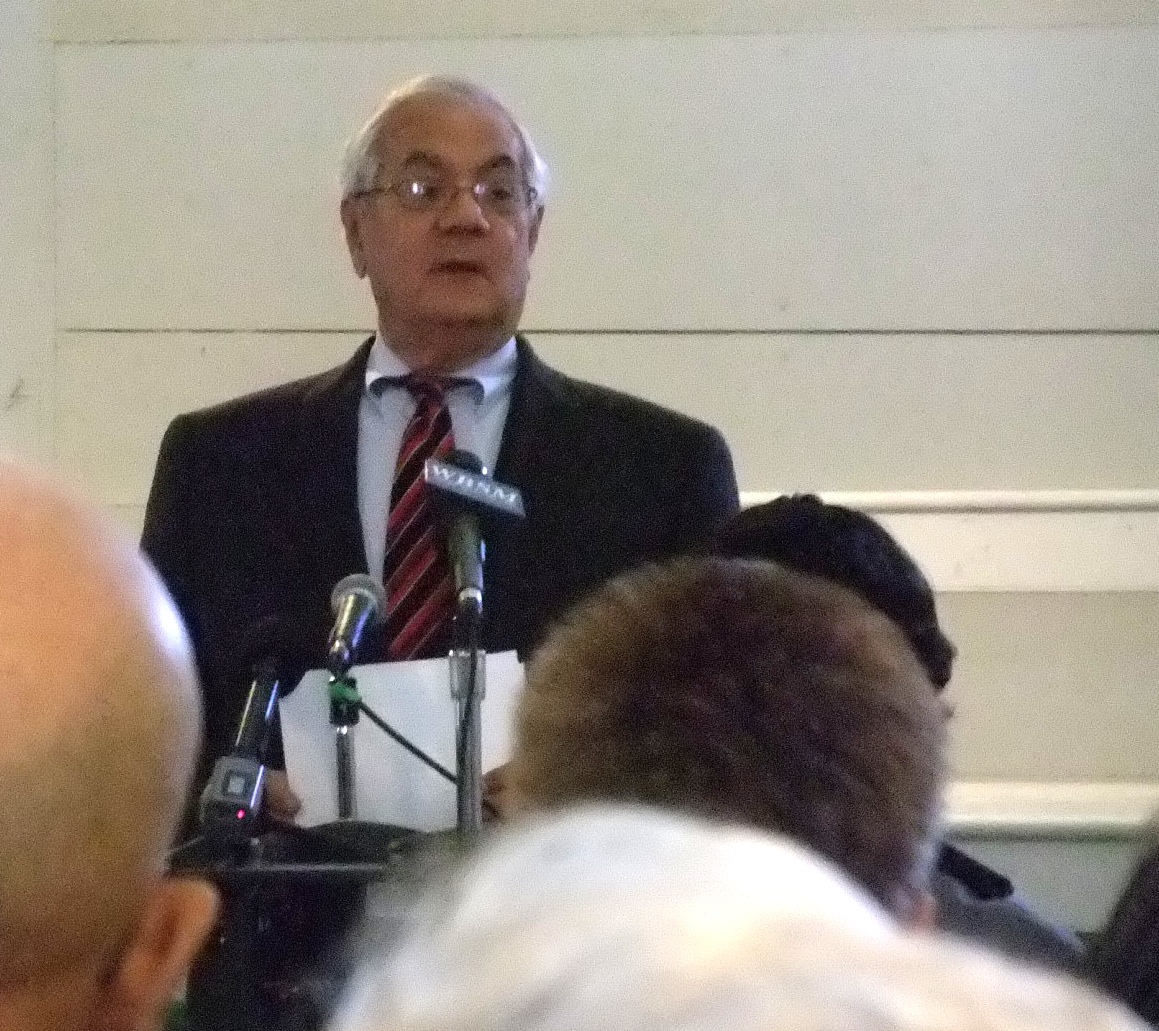
Rep. Barney Frank
Mayor Jon Mitchell
Rep. Wm. Keating
I arrived few minutes early and was struck by the sight of a young woman wearing a tiara! The program revealed that she was the 2012 Miss New Bedford, Marlena Johnson. She kindly posed for a blog photo. (Talk about poise!)

Ms. Johnson opened the event with a superb rendition of "Lift Every Voice." There followed a presentation to U.S. Representative Barney Frank, and a few introductions and announcements. Dr. Mary Louise Francis, Superintendent of Schools, was warmly applauded for her declaration that the Douglass autobiography will be "mandatory reading for New Bedford public schools."

Then we were off. Mr. Frank read first, followed by New Bedford mayor Jonathan Mitchell, and U.S. Representative William Keating.

A few familiar faces from MDM16 were among the readers -- Jen Nersesian (in her Nat'l Historical Park uniform), Scott Lang, Jim Lopes, and Michael Dyer.

Most impressive were the youngest readers, from local grammar and middle schools. I'd say that the future is in good hands.

Scanning the audience, I was reminded of the ethnically diverse New Bedford of Chapter 6 in M-D. We were a mix of cultures, of backgrounds, of ages; husbands and wives, parents and children. While the text described extreme cruelties, we pondered it together, and together marveled at one man's strength and intelligence. Was I the only one who felt a tacit, mutual pledge to look for the best in each other?

Young readers
Young readers
Jim Lopes
Dr. Laurie Robertson-Lorant

Sunday, February 5, 2012

At the Frederick Douglass marathon. Festive, expectant air... [more later]

Saturday, January 21, 2012

Ishmael's Rights, Part III

As I mentioned in a previous post in this series (linked below), to appreciate the psychology in Moby-Dick we need to keep in mind that the Pequod was not a naval ship.  Her crew were employees, not enlisted men subject to military discipline.  They had a contractual relationship with the ship's owners (including Ahab), and the captain and mates could not normally use violence against the crew with impunity.

A fascinating U.S. case on this subject, from 1806, is Thorne v. White (D. Pa. 23 F. Cas. 1132).  The opinion, by Judge Hopkinson, contains much more in the way of instructive material than I could possibly quote here.  As in many other cases brought by seamen, the issue was wages -- specifically, whether the bad conduct of the seaman bringing the case entitled the owners to withhold his pay for the voyage.  This gave Judge Hopkinson the opportunity to discuss at length how the behavior of sailors and captains must be weighed to determine who was most at fault.

It is the duty of seamen to bear even the ill-temper of the master, and to get out of his way, when instances of passion occur. ... Some of the maritime laws are particular in adjusting how a mariner shall demand [sic] himself when the master is enraged, and when he may stand on his defense.  A master must not pursue (as was done in the case before me) a mariner, who flies from him when enraged. ... When the crime of a sailor is too great for the master's authority to punish (which should be evident on the trial, to justify severe measures) the master and his officers are to seize the criminal, put him in irons, and not take the law into their own hands, but bring him to justice on their return.  But the contract for wages is not affected. ...

I have generally thought myself warranted to give a latitude of construction to the words "moderate correction," where chastisement was salutary and merited, and in this I have never been overnice.  The safety of a ship sometimes depends on promptly checking disobedience, and stimulating exertion.  Subordination is peculiarly essential to be enforced, among a class of men whose manners and habits partake of the attributes of the element, on which they are employed. ... [But] instances have not been rare in this court (and they have not been overlooked) where the most enormously cruel, and unjustifiable acts of tyranny, and wanton abuses of power, have been exhibited by masters of ships. ... The sea laws enjoin on the master a temperate demeanor, and orderly and decent conduct, towards seamen.  By several of these laws, he is finable for abusive expressions[!], or misconduct, towards mariners. ... When a mariner is incorrigibly disobedient, and will not submit, and offer to do duty and make amends, the master may discharge him.  He may correct and confine him on board the ship, or dock him of his provisions. 

There is much more worth reading, but I fear I have already tried the reader's patience.  One footnote, however, needs to be quoted in full, because in it the judge describes an earlier case that bears some similarity to the Town-Ho's story:

In a case wherein confinement on board the ship, of two disobedient seamen, appeared to me proper, and indispensable, and where frequent endeavors to reclaim were ineffectually tried, for almost the whole latter section of the return voyage, I held the confinement in irons, so justifiable and necessary for the safety of the ship, that I refused to allow wages for that part of the voyage.  The two seamen were influential characters, and atrocious leaders of a rebellious crew.  [As] they had not misbehaved on the former part of the voyage, I considered it to be a partial breach of contract, and not a forfeiture in toto.  These seamen complained, I thought without cause, of high-handed and cruel treatment.  I left them to their remedy at common law, by action for false imprisonment, or any other mode of redress.
Ishmael's Rights, Part I


Ishmael's Rights, Part II

Tuesday, January 17, 2012

Frederick Douglass autobiography "Read-a-Thon"

Frederick Douglass circa 1855
The work of another author (although that term only hints at his significance) with ties to New Bedford will have a public reading on Sunday, February 5. The New Bedford Historical Society's twelfth annual reading of Narrative of the Life of Frederick Douglass, an American Slave runs from 2-6 PM.

Details, and contact information for volunteer readers, are on the Historical Society's site.

Saturday, January 14, 2012

The 16th New Bedford Moby-Dick Marathon -- the Wee Hours on the Third Day

According the New Bedford Whaling Museum's blog, the 16th Moby-Dick Marathon attracted a record number of visitors -- more than 2,900 over the weekend.  During most of the reading on Saturday, there were few or no empty chairs, unless you resorted to the overflow seating in the Cook Memorial Theater, where the reading was shown remotely with a slight delay. 

Spots in the main seating area, in the Jacobs Family Gallery, did not begin to free up until after the performance of Chapter XL ("Midnight, Forecastle") had concluded in the Theater, at about 10:00 p.m. as I recall.  From this point forward, the year-over-year increase in visitors became less noticeable.  There seemed to be a few more sleepers than at earlier MDMs stretched out on the mezzanine, and the number of awake participants seemed to dwindle more gradually, and to come not quite so close to zero, as in my previous years.


This increase in participation was good for all concerned -- except for us standby readers, whose chances of getting to read are inversely proportional to the number of people who show up.  I did get the opportunity to read once.  My selection happened to be "The Jeroboam's Story" (Ch. LXXI),  which I much prefer to what I read last year, about Derick De Deer and his lamp-feeder (Ch. LXXXI).  But neither I nor any of the other stand-bys had the chance to read more than once during the course of the night.


Just as in MDMs past, between midnight and sunrise, those who remained, and remained awake, were overtaken by the same surreal feeling of being trapped with Ishmael in a sea of darkness, listening to him go on and on, in a stream of seemingly inexhaustible eloquence, about Steelkilt and gams and tuns and sharks and whale skeletons and monstrous pictures and Malaysian pirates.  Meanwhile, the snack food in the break room slowly disappears, while each cup of coffee and tea you drink has less effect than the last.  Close to dawn, like Ishmael trying to make a bed out of a bench at the Spouter Inn, you find that every position you assume is uncomfortable. 

A few times, to stretch my legs, I went out into the dark to get some shots of the deserted New Bedford streets.  By this time, the unusually balmy weather had turned colder.  It was still not as bone-chilling as in prior years, but at least I now found it easier to relate to impoverished Ishmael when he wandered the wintry New Bedford waterfront in search of economical lodgings.

The Rodman Candleworks and part of the "Double Bank" on Water St.
Looking south on Water St. behind the Museum

Friday, January 13, 2012

The 16th New Bedford Moby-Dick Marathon -- Second Day (Part Two)

Immediately after the "Stump the Scholars!" program, the scholars headed over to the Lagoda Room to conduct a reading of the Extracts that preface Moby-Dick.  This was the first time in the history of the New Bedford MDM that the Extracts have been included in the reading.  In prior years, the Marathon has always skipped the Extracts and begun instead with Chapter I ("Call me Ishmael" etc.) -- something that we and other fans have deplored in the past.

Wyn Kelley reads an extract.
The idea behind this Extracts reading was excellent.  The plan was to begin the Extracts at 11:30 a.m. and get through as many of them as possible before noon.  That way, the Marathon formalities could still commence on schedule at the same time as in every other year, without the necessity of determining precisely how long it would take to read all the Extracts.  The scholars stood around the balcony of the Lagoda Room and took turns reading one extract each, an arrangement that made it easy to separate one extract from another and that spared the readers the trouble of reading the source after each extract. 

Jennifer Baker reads; Mary Bercaw Edwards waits her turn.
There was just one problem, which I don't think anyone could have foreseen:  The audience did not seem to grasp that this was part of the reading of Moby-Dick.  Instead of listening quietly as they do to every other part of the book, the audience members talked over the readers as if Melville were just background noise.  As a result, it was nearly impossible to hear the Extracts.  I don't know whether this happened because most people didn't understand what was going on, or because a small number of talkers caused everyone else to give up and talk too, or because most people just don't like the Extracts.

Whatever the cause, I hope the Museum will continue to include the Extracts in future years.  Perhaps if they began the Extracts reading by having someone ring a bell or blow a bos'n's whistle from the podium, and announce what is about to take place, the audience will be more attentive.

After the Extracts, I went out to grab some lunch and take pictures around town.  Gansevoort stayed on and later attended a sort of round-table discussion with the scholars and other serious fans, something I'm sorry to have missed and expect he will write about in the days to come.